For senior Jagger Wraalstad, the choice to study Kinesiology in the College of Education, instead of traditional biological sciences in preparation for medical school, has been a consistently rewarding decision.
A love of athletics, the renown of the department, and the wide range of potential areas of study through electives and affiliated extracurricular activities initially inspired Wraalstad. However, his appreciation of the department’s approach to educating future health and wellness professionals evolved through uncommon experiences, like working alongside college faculty and graduate students on research and lab work. Through collegial collaboration, individual ambition and significant support opportunities, Wraalstad prepares to graduate with a unique understanding of the nexus of medicine and academia, informing his future ambitions to pursue a joint M.D.-Ph.D. and eventually practice sports medicine as an orthopedic surgeon.
Support from the Start
As a recipient of the MSU Alumni Distinguished Scholarship, which grants students tuition for four years and a corresponding professorial assistantship through the Honors College, Wraalstad began his first year in Associate Professor Leapetswe Malete’s lab, assisting with research. Wraalstad recognizes that being welcomed into the lab was a crucial first step in exploring his academic interests, guiding him to the Athletic Injury and Rehabilitation (AIR) Labs, led by Assistant Professor Matt Harkey. In the AIR Labs, Wraalstad worked with Professor Harkey and graduate student mentor Arjun Parmar, deepening his connection to the college and department, broadening his network, and gleaning insight into academia – the importance of research and its impact – and potential professional pursuits beyond graduation.
Soaring on AIR
Donor-supported stipends from the Department of Kinesiology granted Wraalstad the opportunity to continue to work in the AIR Labs on impactful contributions, including academic papers and projects, and presentations at an anticipated 10 conferences and events, by graduation.
The experience is foundational for Wraalstad:
I truly believe that without my involvement in the AIR Labs, through the support of these programs, I would not be as successful as I have been, nor would I be on the same path to pursuing an M.D.-Ph.D. The academic and professional opportunities available to me have been limitless because of these awards.
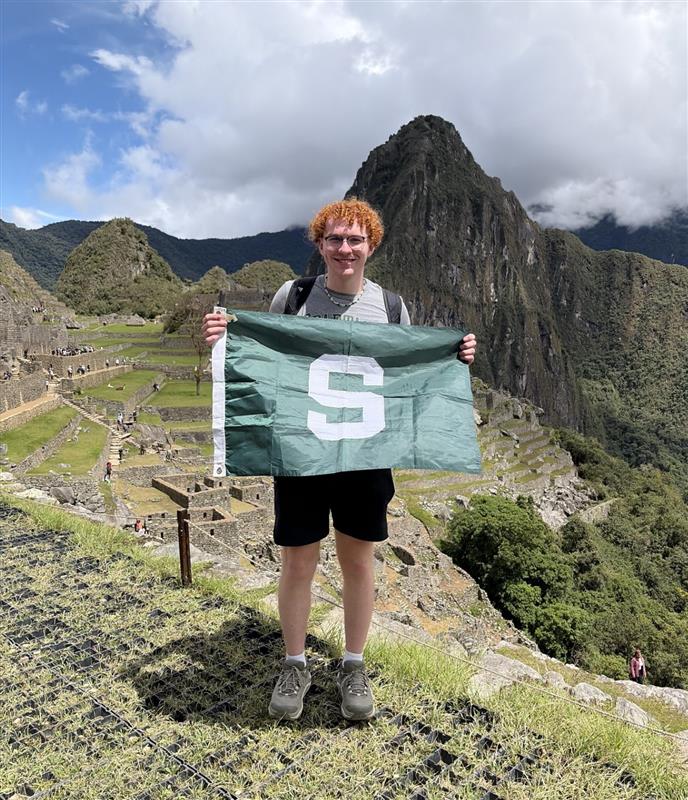
A Presidential Study Abroad award facilitated a trip to Peru, further broadening Wraalstad’s knowledge and preparing him to be a Spartan of global impact.
A-KIN to Nothing Else
Reflecting on the impact of studying kinesiology as a pre-med undergraduate, Wraalstad notes the distinction between the program and the common pursuit of traditional lab sciences of his peers:
I chose to major in kinesiology because of the focus on holistic care and the deep understanding I would gain of the human body. I feel that the interdisciplinary courses in this area have built a strong foundation that will inform my future medical school and Ph.D. experiences.
Beyond the academic, Wraalstad also recognizes the personal significance of the study of kinesiology and a core philosophy of “movement as medicine.” Immersion in this belief for four years inspires Wraalstad to remember the importance of staying physically active throughout the stages of his life as an essential way to improve its overall quality. It is the expectation of the College of Education that Wraalstad will not only improve the quality of his own life, but that of his fellow Spartans and members of the myriad communities they inhabit.