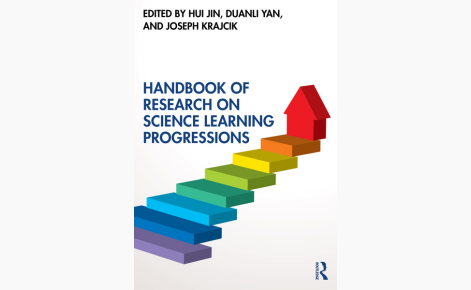
A new book co-edited by University Distinguished Professor Joseph Krajcik presents cutting-edge advancements in science education through a collection of research from scholars worldwide. Published in July 2024 by Routledge, “Handbook of Research on Science Learning Progressions” is the culmination of nearly 25 years of global research into learning progressions and developmental approaches in science education.
Learning progressions are a developmental approach to understanding scientific concepts. It involves helping students build foundational knowledge from an early age and developing their understanding over time through step-by-step learning experiences.
“To truly understand science, we need to shift from telling students information to helping them build a deep understanding through a developmental perspective, starting from an early age and building on concepts over time,” said Krajcik.
The learning progression method contrasts traditional methods that rely on memorization, focusing on gradually developing students’ understanding of challenging concepts instead, so that they can grasp scientific ideas.
Inside the book

The book — also co-edited by scholars Hui Jin from Georgia Southern University and Duanli Yan from Educational Testing Service — features chapters on energy, ecology, genetics and other scientific topics, and includes contributions from Professor Emeritus Andy Anderson and Professor Alicia Alonzo. Additionally, the book features chapters on teaching methodologies, how to support teachers in developing their pedagogical skills and a final chapter authored by Krajcik on the role of artificial intelligence in designing and testing learning progressions.
“The book is primarily intended for educators and researchers dedicated to understanding and advancing science education,” said Krajcik, who is director of the CREATE for STEM Institute and is the Lappan-Phillips Professor of Science Education. “It is also for policymakers, providing insights and summaries that can inform educational policy decisions and support the development of effective science curricula.”
The content is organized into four key sections:
- Section 1: Learning Progression Theories and Methodologies
- Section 2: Learning Progressions to Promote Student Learning
- Section 3: Curriculum, Instruction and Teacher Learning
- Section 4: Applications of Innovative Technology and Artificial Intelligence to Support Learning Progressions