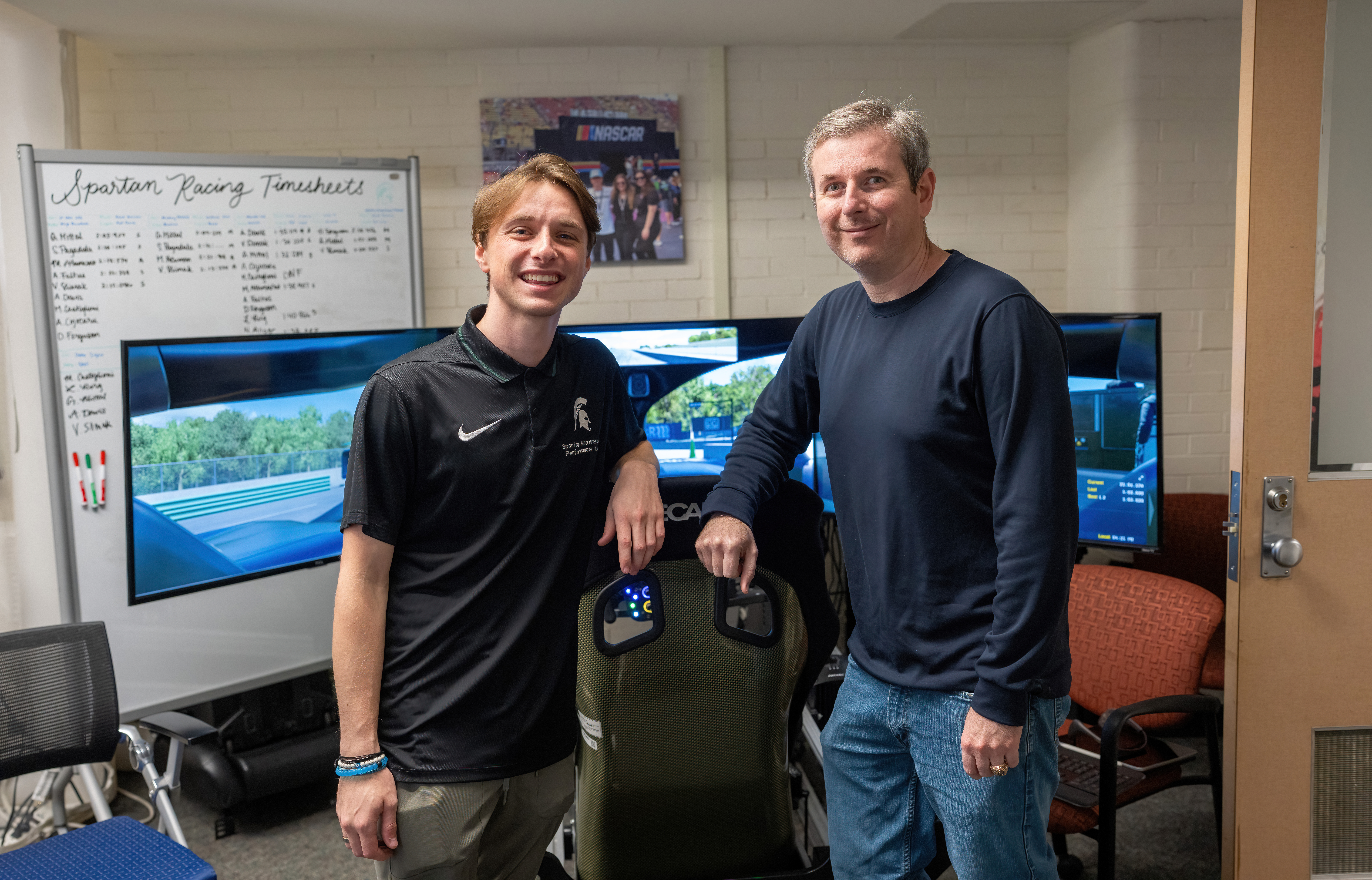
MSU research has established how much physical stress the more than one million race car drivers endure annually. Associate Professor David Ferguson’s trailblazing research has shown the immense pressures (literally) the human body undergoes during automobile racing. Now, he’s on track to lead the way again with the latest research, published in the Medicine & Science in Sports & Exercise journal in March 2026.
The physical effort of the driver coupled with a thick, fire protective suit within a hot race car can increase the risk of heat-related illnesses. Heat-related illnesses, such as heat exhaustion or heat stroke, can create confusion, cause nausea, headaches or seizures, among other symptoms. There are cooling technologies on the market, and Formula 1 now requires that cooling systems are utilized in certain conditions after concerns regarding drivers' safety. Yet, there has been no peer-reviewed literature examining the efficacy of the various technologies.
Enter Ferguson and his research team in the Spartan Motorsport Performance Lab — and research funded by Mercedes Grand Prix Limited, also known as Mercedes-AMG Petronas Formula 1 Team.

“This research will benefit drivers in all series by providing evidence-based recommendations on what cooling technology is the most effective. If teams/drivers follow our recommendations, they could reduce the risk of heat injury and increase safety, driver career longevity and in-car performance,” said Ferguson, who was recently appointed chair of the International Council of Motorsport Sciences. “One thing about this project that I am particularly proud of is that it supported the research goals of Spartan students and alums. This team worked with one of the biggest teams in Formula 1 history. I am proud to have offered this experience to Spartan students”
In addition to Ferguson, the research team includes:
- MSU graduate students (who all also completed undergraduate degrees at MSU) Aidan Davis, Sara Xhaja;
- MSU Kinesiology undergraduate student Gabriel Gulbransen;
- MSU alums Abigail Faltus, M.S. ‘25 (Kinesiology), and Gabriella Pluszczynski, B.S. ‘24 (Kinesiology);
- MSU Kinesiology Assistant Professor Amy Boettcher;
- and global experts Jodi Breach-Teji (Anglia Ruskin University) and Shannon Marchal (Otto-von-Guericke University).
The findings
The team investigated three cooling technologies and various strategies to help identify which product worked best to support racers.
The researchers analyzed heart rate, skin, core temperatures and physiological strain index (PSI). PSI, commonly used in motorsport racing, helps assess the strain on the body by analyzing cardiovascular (heart) and thermoregulatory (temperature) changes.
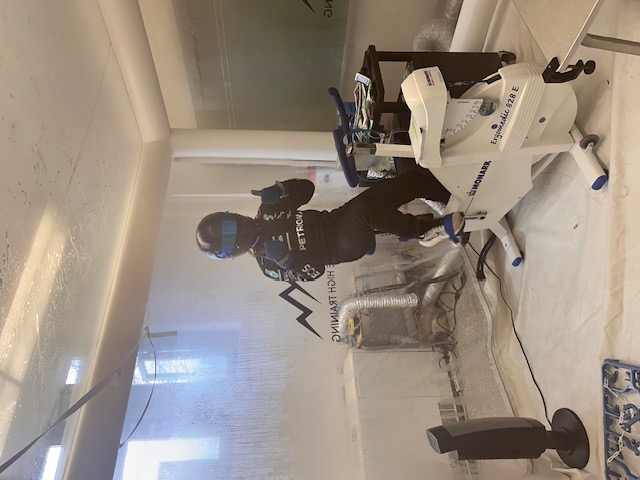
They found the Suit Blower — which blows air directly into the torso area of the fire protective suit — was “the most effective at mitigating heat illness in a [lab] model for race car driver heat stress,” the researchers wrote in the paper. Though the Suit Blower was developed in the early 2000s, and was “highly praised by drivers” at the time for its cooling effectiveness, the product is not currently commercially available. As part of its study highlights, the Suit Blower was the best at maintaining a skin temperature (where skin temperature increased when using the other technologies). Researchers also found the Suit Blower provided the lowest PSI, or the lowest physiological stress.
The Helmet Blower — which blows air into the helmet of the driver, not the torso area — performed almost as good as the Suit Blower when assessing core temperature throughout the study. The Helmet Blower was also praised by the participants.
A third technology, the Cool Shirt, was also tested. It is a long-sleeved shirt worn under the fire suit and commonly used in motor sports; in fact, Formula 1 has mandated Cool Shirts for the 2026 season during hot conditions. The shirt includes tubes that circulate water between the shirt and a cooler. Among the findings, the researchers discovered that after 30 minutes the Cool Shirt “elicited the highest PSI,” even higher than the control condition of no cooling techniques or strategies. And while the Cool Shirt did reduce skin temperatures, it failed to reduce core body temperatures at the end of the study.
Student research and success
The study could not have been completed without students.
“Research has been a huge part of my growth as a student. It allowed me to combine my interests in medicine and motorsports while contributing to something that could directly improve driver safety,” said Davis, the first author on the study and a second-year medical student in MSU’s College of Osteopathic Medicine. Davis has worked with Ferguson and his lab for five years.

“Motorsport has always been a personal passion of mine, so having the opportunity to study how science and medicine can make the sport safer has made this research especially meaningful. Through this project, I had the opportunity to travel to the 2025 Formula 1 Belgian Grand Prix (at Spa-Francorchamps in Stavelot, Belgium) with the Mercedes-AMG Petronas Formula 1 Team to present some of the data. Being able to work trackside and see how research translates directly into protecting driver health and performance was an experience I never could have never imagined when I first started as an undergraduate student to now as a medical student.”
Davis and Ferguson were among the Spartans represented at the recent Racing Days at Michigan’s Central Station. Davis led a conversation with Trifun Dimitrijevski (assistant professor at Wayne State University and chief medical officer of Detroit Grand Prix) on “what it takes to keep drivers safe.”
Knowledge of driver safety is now expanded thanks to the work of Davis, Ferguson and the others on the Mercedes-funded work.