Imagine a classroom where conversation is encouraged.
A teacher may show students an image of a plant growing in an unusual place (such as in a gutter on a roof, or in a crack on a rock) and ask, “How do you think the plant got there?”
Hands will rise, some confident, some tentative. Students will shout out ideas, which may prompt other students to recall their own experiences with plants and enter the conversation. Someone might ask a question, and someone might share a fact they know about different types of plants.

This is science talk, or a way of engaging with science in the classroom.
Beyond the teacher reciting facts — “seeds can be dispersed by the wind” or “plants need water and sunlight to grow” — science talk engages learners in discussions to promote sense-making about scientific phenomena. Research (including by MSU scholars) suggests that these classroom-based conversations promote deeper science learning and language development.
But how can teachers effectively use science talk in their classrooms?
A free tool co-developed by an MSU scholar and alums will help educators learn about and deliver high-quality science talk in their classrooms.
Beyond words
According to research by Professor Amelia Wenk Gotwals, “high-quality science talk” occurs when it creates opportunities for engagement and participation for all students, deepens science reasoning over time, and develops disciplinary literacy for science. Gotwals stresses that it should be more than one opportunity, and that the types of talks matter as much as the frequency. For example, students should engage in questioning, explaining and using evidence to support their reasoning.

The same is true for teachers, who cannot simply take a single professional development opportunity and master the art of facilitating science talk. Evidence suggests that to implement a teaching strategy (like science talk) effectively, educators should get regular support or coaching on that strategy.
That’s why the SOLID Start Tool was created.
The MSU-developed SOLID Start Curriculum for K-2 classrooms has been in existence since 2015. Co-created by Gotwals, it helps integrate Science, Oral Language and Literacy Development (SOLID) from the Start of schooling. The complementary tool will help teachers effectively implement this free curriculum in their classrooms.
To ensure the tool worked as intended, a group of scholars conducted a research study. They published their findings in the Elementary School Journal. They found that the SOLID Start Tool does help K-2 teachers understand and use science talk in their classrooms.
The research team includes scholars and alums from SOLID Start, including:
- Amelia Wenk Gotwals (MSU)
- Tanya S. Wright (University of Michigan)
- Arianna Pikus (Texas A&M University)*
- Blythe E. Anderson, Ph.D. ‘20 (University at Buffalo)
- Lisa Domke, Ph.D. ‘19 (Georgia State University)
“[The tool] really gave us a starting point,” one teacher who participated in the research said. “So instead of ... being very overwhelmed with what to pick apart, and what to look at, and where to start, and how to get better, it gave us a starting point on what to look at and it gave us what it should be.”
In addition to examples of what science talk looks like in the classroom and concrete strategies to try, the SOLID Start Tool can be used by instructional coaches to support teachers in reflecting on their science instruction and developing new ways of providing opportunities for children to engage in the types of rich science talk the tool embodies.
Supporting teachers
When used in practice, the tool guides teachers to reflect on what happened during class time, thereby improving future class sessions. Some educators noted areas where they could improve, such as identifying when the teacher spoke too much and the students did too little.
This, researchers say, is the key idea of the SOLID Start Tool. It was created to support changes in teacher practices.
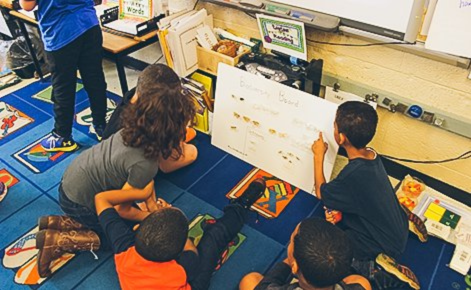
“The most helpful part was it [the SOLID Start Tool] did make me really intentionally think about this during this part of the lesson,” one teacher said. “[For example,] I want to hit on this part because it’s going to be most helpful to them [students], they’re going to get the most out of it.”
The researchers say that the tool is just that, a tool. It is effective, helpful and — as one teacher suggested — it is "purposeful". But it shouldn’t be the only way educators assess the efficacy of their lessons or the knowledge of their students. It can, and should, be used in tandem with other tools and coaching materials.
“Children in elementary classrooms are curious about the world around them and deserve opportunities to engage in rich discussions around science,” said Gotwals, a professor in the Department of Teacher Education. “We hope that this Tool can support teachers in engaging their students in sensemaking science talk, which we know has positive implications for both science and literacy learning.”
Learn about SOLID Start and access the SOLID Start Tool on our website: Start here.
*Arianna Pikus is also an MSU graduate, earning a Ph.D. in Human Development and Family Studies in 2023.