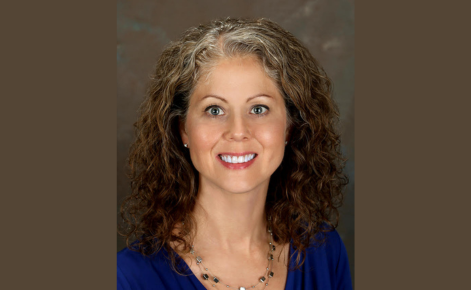
Elizabeth Hicks, a Ph.D. student in Michigan State University’s Special Education program, is a recipient of the Badar-Kauffman Early Career Scholar Award for her research exploring reading intervention in adult correctional facilities – or the lack thereof. Each year, the award recognizes outstanding research contributions of doctoral students at the Badar-Kauffman Conference.
The National Adult Literacy Survey reports that 70% of incarcerated adults are unable to read at a fourth-grade level. According to Hicks, evidence-based research available for prison educators to remedy the situation is low.
“There is a low publication rate and not much dissemination of research in the area of reading interventions in correctional facilities,” said Hicks. “We have really limited tools to offer correctional educators as far as evidence-based practice, because we just don’t have much evidence.”
Of the dozens of doctoral students who presented their posters at the Badar-Kauffman Conference in April 2024, Hicks’ poster presentation was chosen for the award.
Her research outlines the current state of literacy intervention research within adult correctional education, highlighting the need for sound research to guide educational practices. Her analysis of the literature showed that while 80% of the studies showed positive outcomes, only 20% involved randomized controlled trials, highlighting a critical gap in high-quality research in this field.
A two-time Spartan graduate, Hicks has benefited from the learning and mentorship of faculty at the College of Education, but especially from Associate Professor Troy Mariage, who serves as her advisor. “He [Troy Mariage] goes above and beyond and then some for his students,” she said. “He has made an incredible impact on me.”
Prior to her doctoral pursuit, Hicks spent 18 years as a special education teacher and five as an administrator in PK-12 education.
Long-term, Hicks hopes to develop targeted recruitment practices for intervention and a multi-tiered system of support for literacy, enhancing educational outcomes for incarcerated individuals.
“Influencing the incarcerated towards literacy doesn’t just impact them; it reverberates in the communities we strive to make better,” said Hicks, who pointed out the United States houses 25% of the world’s incarcerated population despite making up only 8% of the global population