Jump to HeaderJump to Main ContentJump to Footer
Michigan State University
College of Education
  • Strategic Plan
  • Resources
  • People Directory
  • Alums
  • Contact
  • Give

College of Education

  • About
    • Mission & History
    • Strategic Plan
    • Points of Distinction
    • Leadership
    • Academic Departments, Centers, Institutes & Offices
    • Faculty and Staff Directory
    • Inclusion & Diversity
    • Outreach Efforts
    • Buildings & Facilities
    • Career Opportunities
    • Ways to Give
    Dean Jerlando Jackson stands in front of a sign that reads Michigan State University.

    Meet Dean Jackson

    Meet Dean Jerlando F. L. Jackson
  • |
  • Academics
    • Majors & Degree-Granting Programs
    • Undergraduate Programs
    • Master's Studies
    • Doctoral Studies
    • Online Studies
    • Graduate Certificates & Specializations
    • Undergraduate Student Support
    • Graduate Student Support
    • Assistantships
    • Scholarships
    • Accreditation
  • |
  • Certifications
    • Become Certified or Add an Endorsement
    • School Psychologist Certification
    • Student Affairs Office
    • MSU Academic Programs Catalog
    • MSU Office of Accreditation, Assessment, Curriculum & Compliance
    Individual bikes on MSU's campus

    Educator Preparation & Accreditation

    Explore our efforts
  • |
  • Research
    • Office of Research Administration
    • Centers & Institutes
    • Student Research Opportunities
    • Research & Award News
    • Faculty Directory
    Aerial view of a driver in a race car

    Cooler, safer race car tech via MSU study

    Read about our research
  • |
  • Outreach
    • Policy
    • K-12 Schools & Districts
    • Urban Areas
    • International Areas
    • Alumni
    • Institute for the Study of Youth Sports
    • Office of Access & Community Engagement
    • Office of International Studies in Education
    • Office of K-12 Outreach
    • All Offices, Centers & Institutes
    oise

    40+ years of the Office of International Studies

    Explore our impact
  • |
  • News & Events
    • News
    • New Educator Magazine
    • Subscribe: ReviewED Newsletter
    • Events Listing
    Ann Austin poses for the camera in front of a bookshelf

    Celebrating: Ann E. Austin

    Austin named Fellow of American Association for the Advancement of Science
College of Education
  • About
  • Academics
  • Certifications
  • Research
  • Outreach
  • News & Events

< About

  • Mission & History
  • Strategic Plan
  • Points of Distinction
  • Leadership
  • Academic Departments, Centers, Institutes & Offices
  • Faculty and Staff Directory
  • Inclusion & Diversity
  • Outreach Efforts
  • Buildings & Facilities
  • Career Opportunities
  • Ways to Give
Dean Jerlando Jackson stands in front of a sign that reads Michigan State University.

Meet Dean Jackson

Meet Dean Jerlando F. L. Jackson

< Academics

  • Majors & Degree-Granting Programs
  • Undergraduate Programs
  • Master's Studies
  • Doctoral Studies
  • Online Studies
  • Graduate Certificates & Specializations
  • Undergraduate Student Support
  • Graduate Student Support
  • Assistantships
  • Scholarships
  • Accreditation

< Certifications

  • Become Certified or Add an Endorsement
  • School Psychologist Certification
  • Student Affairs Office
  • MSU Academic Programs Catalog
  • MSU Office of Accreditation, Assessment, Curriculum & Compliance
Individual bikes on MSU's campus

Educator Preparation & Accreditation

Explore our efforts

< Research

  • Office of Research Administration
  • Centers & Institutes
  • Student Research Opportunities
  • Research & Award News
  • Faculty Directory
Aerial view of a driver in a race car

Cooler, safer race car tech via MSU study

Read about our research

< Outreach

  • Policy
  • K-12 Schools & Districts
  • Urban Areas
  • International Areas
  • Alumni
  • Institute for the Study of Youth Sports
  • Office of Access & Community Engagement
  • Office of International Studies in Education
  • Office of K-12 Outreach
  • All Offices, Centers & Institutes
oise

40+ years of the Office of International Studies

Explore our impact

< News & Events

  • News
  • New Educator Magazine
  • Subscribe: ReviewED Newsletter
  • Events Listing
Ann Austin poses for the camera in front of a bookshelf

Celebrating: Ann E. Austin

Austin named Fellow of American Association for the Advancement of Science
  • Strategic Plan
  • Resources
  • People Directory
  • Alums
  • Contact
  • Give

Jan. 31, 2022

MSU research finds surprising negative link between growth restriction, exercise

Summary

For many, New Year’s resolutions included exercising more often. Exercise can help improve the body’s function and feeling and has been proven to reduce health risks, like heart disease. There may be a catch to that premise that exercise is inherently good: A surprising finding by Michigan State University researchers may impact some growth restricted… Read More »

For many, New Year’s resolutions included exercising more often. Exercise can help improve the body’s function and feeling and has been proven to reduce health risks, like heart disease.

There may be a catch to that premise that exercise is inherently good: A surprising finding by Michigan State University researchers may impact some growth restricted individuals when they are physically active.

“We used a mouse model for growth restriction to determine if exercise improved cardiac function,” said David Ferguson, assistant professor in the MSU Department of Kinesiology. “We found growth-restricted mice didn’t respond to exercise. In fact, it worsened the mice’s health outcomes.”

The findings, published in the Medicine & Science in Sports & Exercise journal, could have impacts for millions around the world.
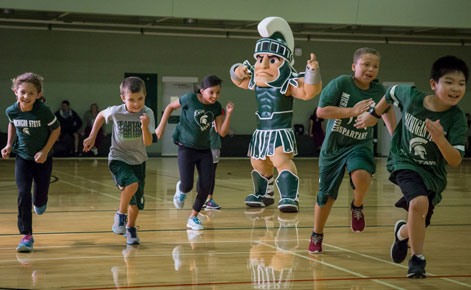
Children race with Sparty during a pre-2020 event. Photo: Amanda Pinckney, WKAR-MSU.

Growth restriction is most common for those who were born prematurely, with low birth weight (under five pounds), steadily trend lower than the 25th percentile on growth charts in early life or consistently receive poor nutrition. The World Health Organization estimated 149.2 million children under the age of 5 were “stunted” in growth due to malnutrition in 2020. Growth restrictions, such as this, can have a detrimental and long-lasting effect later in life, such as with increased likelihood of developing Type 2 diabetes, hypertension and other health challenges.

Research has also proven physical activity, or exercise, can improve cardiovascular functions and improve muscle strength.

So, when MSU researchers in the Neonatal Nutrition and Exercise Research Lab began studying growth-restricted mice, they expected to find similar results: Exercise is good.

Surprisingly, they found the opposite.

David Ferguson headshot
David Ferguson

While the control group of mice expanded exercise capacity, the test groups consistently saw negative impacts to body function. For example, postnatal female mice that were growth restricted and that exercised had 11.45% lower ventricular volume and an 18% lower left ventricle area. The blood flow velocities in growth-restricted gestational and postnatal female mice were indicative of cardiac fibrosis. Cardiac fibrosis is the process by which the muscle of the heart becomes stiff, thick or scarred as a result of injury or disease and is often associated with heart failure.

“As adverse outcomes to physical activity are rare,” the August 2021 publication states, “it was not expected to occur.”

The researchers—which includes Kinesiology graduate students and alumni Eric Leszcynski, Ashley McPeek, Logan Pendergast, Joseph Visker and Ashley Triplett—are eager to conduct follow-up work.

Why did this happen?

It comes down to molecules and biological programming, says Ferguson.

“Protein is made up of amino acids, which are the building blocks for everything. They make your muscles, organs, skin. You need a certain amount of it in your diet; if you don’t get it, those tissues don’t grow,” he explained. “The body then responds to those lack of nutrients by slowing down. To survive, you need to not waste the precious calories you do have. Your body will be more inclined to be still, not move as much. With that, it hinders your heart’s ability to respond to exercise, so that when you do exercise, your body will respond negatively.”
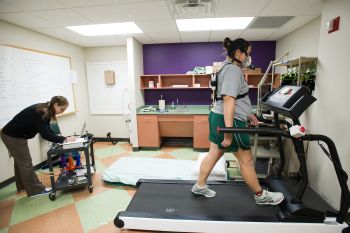
A pregnant female exercises on a treadmill in IM Circle (2011). Growth-restricted gestational and postnatal female mice were found to have negative health outcomes following exercise.

The heart responds best when its pumping mechanism is flexible. The more individuals exercise, the more the organ gets stretched and increases capacity for more (and more strenuous) activities. For growth-restricted mice—and humans—when they can’t or don’t exercise, the heart doesn’t stretch and therefore becomes stiff, which can lead to cardiac fibrosis.

What can I do?

The results are not a one-size-fits-all finding. Physical activity is still beneficial—the key is being attuned to the body’s response.

Not everyone who was born prematurely or with low birth weight will experience the same effects, Ferguson says, but it is important for every individual to listen to how their own body is responding to exercise with blood pressure and heart rate.

It is also key to focus on health in early life. For caregivers of young children, Ferguson recommends a steady and increased amount of protein in diets and encourages children to exercise and move often.


Related news: The power of movement

  • DIABETES AND PHYSICAL ACTIVITY: In his work in the Motorsport Performance Lab, Ferguson is pioneering research to fuel athletic excellence—and drive change for diabetes in sport (2017, New Educator). The work is making a difference on the racetrack: With help from findings at Ferguson’s lab, motorsport driver Charlie Kimball, a Type 1 diabetic, was able to go four seconds faster on the track; a critical competitive-edge in sport racing (2018).
  • HOW WE LEARN TO MOVE: A decades-long study at MSU examined questions such as: How do we grow and learn motor skills, such as jumping, throwing and running? What changes in our body, brain and environment influence our physical maturation and skills? (2021, New Educator)
  • GETTING A BETTER WORKOUT—IN ISOLATION: Research from MSU Kinesiology Professor Emerita Deb Feltz has the answer for those who want to stay fit (and stay motivated to stay fit!), but are isolated from physical activity centers due to COVID-19 (2021, New Educator)
  • STEREOTYPES & EXERCISE: Kinesiology alum Tayo Moss explored how perceived stereotypes impacted performance. The findings could impact the way we view teamwork. (2021, New Educator)
  • MEET ASHLEY TRIPLETT: Triplett, one of the authors of the study, joined the MSU Kinesiology faculty in fall 2021 as an assistant professor. Her research focuses on the impact of anterior cruciate ligament (ACL) reconstruction on health-related factors—including physical activity participation. Learn more about Ashley and other new faculty who joined the College of Education.

Programs

  • Undergraduate Programs
  • Master's Programs
  • Doctoral Programs
  • Online Programs

Academic Departments

  • Counseling, Educational Psychology & Special Education
  • Educational Administration
  • Kinesiology
  • Teacher Education

For Students

  • Graduate Support
  • Undergraduate Support
  • Scholarships
  • Assistantships

For Faculty & Staff

  • Communications
  • Data & Analytics
  • Human Resources
  • Policies, Committees & More
  • Tech Services

Our College

  • Office of the Dean
  • Imagin[ED] 2030 Strategic Plan
  • Mission
  • Directory
  • Centers & Institutes
  • Accolades & Awards
  • Rankings
  • Subscribe to our Newsletter
  • "New Educator" Magazine
  • News
  • Jobs

Contact us

(517) 355-1734

Address

Michigan State University College of Education 620 Farm Lane East Lansing, MI 48824

Releases and Statements

Follow Us

  • Visit our Facebook page
  • Visit our page on X
  • Visit our Instagram page
  • Visit our LinkedIn page
  • Visit our YouTube page

If you're having accessibility issues, please let us know.

Know More: Campus Safety Information and ResourcesTransparency Reporting: Budget & Salary/Compensation
  • Contact Information|
  • Site Map|
  • Privacy Statement|
  • Site Accessibility|
  • Call MSU: (517) 355-1855|
  • Visit: msu.edu|
  • Notice of Nondiscrimination|

SPARTANS WILL|© Michigan State University|