Jump to HeaderJump to Main ContentJump to Footer
Michigan State University
College of Education
  • Strategic Plan
  • Resources
  • People Directory
  • Alums
  • Contact
  • Give

College of Education

  • About
    • Mission & History
    • Strategic Plan
    • Points of Distinction
    • Leadership
    • Academic Departments, Centers, Institutes & Offices
    • Faculty and Staff Directory
    • Inclusion & Diversity
    • Outreach Efforts
    • Buildings & Facilities
    • Career Opportunities
    • Ways to Give
    Dean Jerlando Jackson stands in front of a sign that reads Michigan State University.

    Meet Dean Jackson

    Meet Dean Jerlando F. L. Jackson
  • |
  • Academics
    • Majors & Degree-Granting Programs
    • Undergraduate Programs
    • Master's Studies
    • Doctoral Studies
    • Online Studies
    • Graduate Certificates & Specializations
    • Undergraduate Student Support
    • Graduate Student Support
    • Assistantships
    • Scholarships
    • Accreditation
  • |
  • Certifications
    • Become Certified or Add an Endorsement
    • School Psychologist Certification
    • Student Affairs Office
    • MSU Academic Programs Catalog
    • MSU Office of Accreditation, Assessment, Curriculum & Compliance
    Individual bikes on MSU's campus

    Educator Preparation & Accreditation

    Explore our efforts
  • |
  • Research
    • Office of Research Administration
    • Centers & Institutes
    • Student Research Opportunities
    • Research & Award News
    • Faculty Directory
    Aerial view of a driver in a race car

    Cooler, safer race car tech via MSU study

    Read about our research
  • |
  • Outreach
    • Policy
    • K-12 Schools & Districts
    • Urban Areas
    • International Areas
    • Alumni
    • Institute for the Study of Youth Sports
    • Office of Access & Community Engagement
    • Office of International Studies in Education
    • Office of K-12 Outreach
    • All Offices, Centers & Institutes
    oise

    40+ years of the Office of International Studies

    Explore our impact
  • |
  • News & Events
    • News
    • New Educator Magazine
    • Subscribe: ReviewED Newsletter
    • Events Listing
    Ann Austin poses for the camera in front of a bookshelf

    Celebrating: Ann E. Austin

    Austin named Fellow of American Association for the Advancement of Science
College of Education
  • About
  • Academics
  • Certifications
  • Research
  • Outreach
  • News & Events

< About

  • Mission & History
  • Strategic Plan
  • Points of Distinction
  • Leadership
  • Academic Departments, Centers, Institutes & Offices
  • Faculty and Staff Directory
  • Inclusion & Diversity
  • Outreach Efforts
  • Buildings & Facilities
  • Career Opportunities
  • Ways to Give
Dean Jerlando Jackson stands in front of a sign that reads Michigan State University.

Meet Dean Jackson

Meet Dean Jerlando F. L. Jackson

< Academics

  • Majors & Degree-Granting Programs
  • Undergraduate Programs
  • Master's Studies
  • Doctoral Studies
  • Online Studies
  • Graduate Certificates & Specializations
  • Undergraduate Student Support
  • Graduate Student Support
  • Assistantships
  • Scholarships
  • Accreditation

< Certifications

  • Become Certified or Add an Endorsement
  • School Psychologist Certification
  • Student Affairs Office
  • MSU Academic Programs Catalog
  • MSU Office of Accreditation, Assessment, Curriculum & Compliance
Individual bikes on MSU's campus

Educator Preparation & Accreditation

Explore our efforts

< Research

  • Office of Research Administration
  • Centers & Institutes
  • Student Research Opportunities
  • Research & Award News
  • Faculty Directory
Aerial view of a driver in a race car

Cooler, safer race car tech via MSU study

Read about our research

< Outreach

  • Policy
  • K-12 Schools & Districts
  • Urban Areas
  • International Areas
  • Alumni
  • Institute for the Study of Youth Sports
  • Office of Access & Community Engagement
  • Office of International Studies in Education
  • Office of K-12 Outreach
  • All Offices, Centers & Institutes
oise

40+ years of the Office of International Studies

Explore our impact

< News & Events

  • News
  • New Educator Magazine
  • Subscribe: ReviewED Newsletter
  • Events Listing
Ann Austin poses for the camera in front of a bookshelf

Celebrating: Ann E. Austin

Austin named Fellow of American Association for the Advancement of Science
  • Strategic Plan
  • Resources
  • People Directory
  • Alums
  • Contact
  • Give

March 25, 2013

How school report cards can backfire

Summary

In the wake of President Obama’s “college scorecard,” new research finds that government attempts to grade educational institutions can backfire when done for political or policy purposes. Rebecca Jacobsen of Michigan State University studied the effects of publicizing performance data for K-12 schools, which was mandated by No Child Left Behind in 2001. While Jacobsen… Read More »

Jacobsen-TE250-001

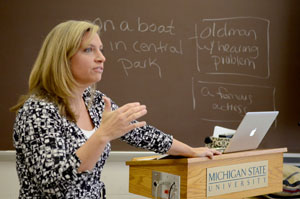
Researcher Rebecca Jacobsen

In the wake of President Obama’s “college scorecard,” new research finds that government attempts to grade educational institutions can backfire when done for political or policy purposes.

Rebecca Jacobsen of Michigan State University studied the effects of publicizing performance data for K-12 schools, which was mandated by No Child Left Behind in 2001. While Jacobsen believes school report cards are warranted to keep the public informed, she said too often the information presented is unclear or misleading to parents and can ultimately erode trust in the schools.

And now comes the president’s interactive scorecard for colleges and universities. In his February State of the Union address, Obama said the scorecard compares schools “based on a simple criteria: where you can get the most bang for your educational buck.”

Jacobsen, assistant professor of teacher education, said attempting to determine the value of a college or K-12 education with a set of data can be a dangerous proposition.

“It can be scary, because they’re trying to give you a prototype that attempts to get at the value of an education,” Jacobsen said. “But how do we determine value? I may value the network I develop, while someone else may value the diversity of courses or another facet of the educational experience.”

While K-12 schools may share a more common mission than colleges and universities, the data used to grade any educational institution can have unintended consequences.

“It’s a growing problem,” Jacobsen said. “Policymakers and state legislators have realized they need to put the data out there in a way that’s clear, but sometimes those efforts toward clarity are actually backfiring.”

In New York City, where K-12 schools are given a simple letter grade, education officials in 2010 capped the number of schools that could receive an “A.” Consequently, many schools saw grades fall even though student performance did not necessarily drop.

The result, as Jacobsen discusses in the March/April issue of Educational Policy, was a drop in parent satisfaction with the schools. In addition, increased grades did not boost parent satisfaction, suggesting the psychological effect of declining grades has a larger effect than seeing a school maintain or improve its performance.

Raising the bar on student performance has been shown to spur academic achievement in school districts, making it an appealing policy, Jacobsen said. But little attention has been paid to how the public is influenced by the report cards that publicize the results.

Long-term consequences of decreased parent satisfaction could include a decline in enrollment, donations and volunteers, and even a drop in housing values, which are tied to the community schools.

Many states and school districts have changed their grading systems from year to year. Jacobsen said they should pick one system that’s easy to understand and then focus on parent outreach.

“In our rush to produce data of all shapes and sizes and then reshape these data for policy or political purposes, we cannot forget to consider how the public is interpreting these data,” Jacobsen said. “Parents want one clear number, and I don’t think we should monkey with that number.”

The study was co-authored by Andrew Saultz and Jeffrey Snyder, both doctoral students in the Educational Policy program at MSU.

Programs

  • Undergraduate Programs
  • Master's Programs
  • Doctoral Programs
  • Online Programs

Academic Departments

  • Counseling, Educational Psychology & Special Education
  • Educational Administration
  • Kinesiology
  • Teacher Education

For Students

  • Graduate Support
  • Undergraduate Support
  • Scholarships
  • Assistantships

For Faculty & Staff

  • Communications
  • Data & Analytics
  • Human Resources
  • Policies, Committees & More
  • Tech Services

Our College

  • Office of the Dean
  • Imagin[ED] 2030 Strategic Plan
  • Mission
  • Directory
  • Centers & Institutes
  • Accolades & Awards
  • Rankings
  • Subscribe to our Newsletter
  • "New Educator" Magazine
  • News
  • Jobs

Contact us

(517) 355-1734

Address

Michigan State University College of Education 620 Farm Lane East Lansing, MI 48824

Releases and Statements

Follow Us

  • Visit our Facebook page
  • Visit our page on X
  • Visit our Instagram page
  • Visit our LinkedIn page
  • Visit our YouTube page

If you're having accessibility issues, please let us know.

Know More: Campus Safety Information and ResourcesTransparency Reporting: Budget & Salary/Compensation
  • Contact Information|
  • Site Map|
  • Privacy Statement|
  • Site Accessibility|
  • Call MSU: (517) 355-1855|
  • Visit: msu.edu|
  • Notice of Nondiscrimination|

SPARTANS WILL|© Michigan State University|