By Lauren Knapp
In July 2025, an executive order from President Donald Trump started the process of reinstating the Presidential Fitness Test and revitalizing the President’s Council on Sports, Fitness and Nutrition.1 Per the executive order, these efforts are being undertaken to “reverse” the U.S. “health crisis” of “declining health and physical fitness.”
The Presidential Fitness Test has its origins in the President Dwight Eisenhower administration in the 1950s. It was discontinued by President Barack Obama’s administration in 2012.
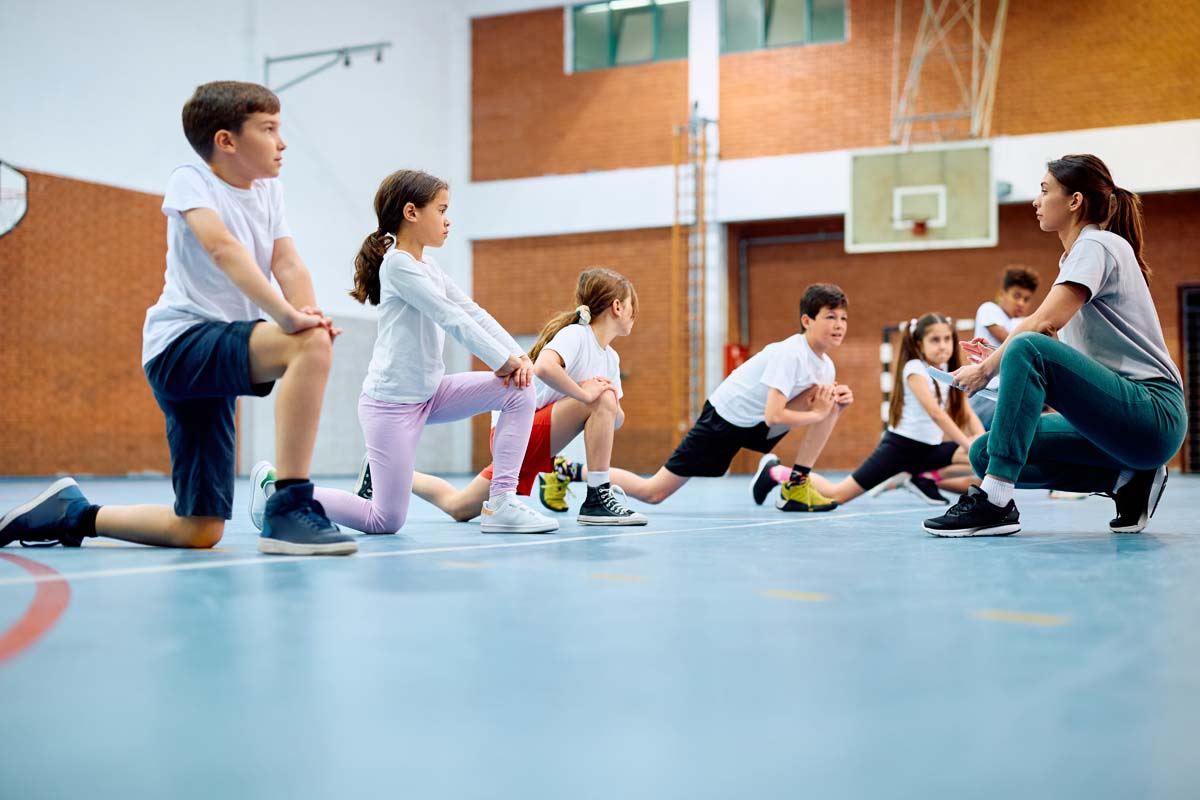
Despite its promise to promote healthier schools, the return of the Presidential Fitness Test has MSU Kinesiology scholars questioning whether its troubled history will undermine its goals.
“The goals for the council and the test are good, wonderful even,” says Jackie Goodway, a Red Cedar Distinguished Professor and associate chair of the Department of Kinesiology. “Anything that elevates a focus on physical activity and fitness is a good thing. But I have concerns about how this will get implemented.”
Recommendations from the U.S. Department of Health and Human Services range on how to meet the national guidelines for children.2 But, critically, many do not meet the guidelines regularly, if at all. In fact, research MSU Professor Karin Pfeiffer contributed to suggests only about 50% of children and adolescents meet the recommendations.3
So, it’s no wonder that scholars like Associate Professor Spyridoula Vazou say: “We do need measurement of what kids are doing. We don’t have data to evaluate how well we’re doing in certain areas. However, the purpose of this test does not fit this need. The way it’s been done before, you’ll get data, yes. But it won’t influence the right kind of behavior. The negatives will outweigh the positives.”
Historical reactions: Demoralizing, Traumatizing
Vazou’s research has centered on how physically active environments can promote learning, cognitive function and academic performance. She developed statewide programs while on faculty at Iowa State University, and is working to do the same in Michigan. In a published study4, Vazou and fellow researchers examined the efficacy of the Presidential Fitness Test.
“We tested exactly the way it is supposed to be done in a physical education lesson. Then we had a different option with the same intensity and activities, but we added music, we had kids run in different directions, give high fives, that sort of thing. We turned it into a game,” Vazou describes. “The fitness activities were the same, and the intensity was vigorous in both lessons, but all participants said they wanted to do the novel lesson again. Most said they didn’t want to do the traditional fitness test again.”
Vazou’s research encourages a different take on physical activity. Push-ups and pull-ups, as used in the Presidential Fitness Test, are great physical activities, but can have drawbacks when used in a competitive environment. Instead, Vazou encourages, schools and educators can ensure the activities are fun, are structured in a way that avoids peer comparisons (e.g., who can run the fastest mile) and include positive social interactions. When done in this way, the physical benefits are similar and the students are more likely to be motivated to do them and, therefore, develop positive lifelong fitness habits.
Vazou describes the idea like this: “I need to be able to read books, that’s how I become literate. But if I’m not confident in it or if it is boring, I’m not going to do it,” she says. “It’s the same thing with physical activity. We need to have the skills to feel comfortable. If we can make it motivating and help students to think it’s fun, those roots will help them thrive.”
That’s where Goodway’s research comes in.
It’s a “spiral of engagement,” Goodway says5, which suggests why the Presidential Fitness Test, as it was previously enacted, had negative results.
“In the classroom, if I’m not good at a subject, that’s a private failure between my teacher and me. But if I’m last in the mile run, everyone sees that. The Presidential Fitness Test allowed extreme moments of public failure that directly integrated into an individual’s desire, or lack of desire, to be more active,” Goodway suggests. “The test was demoralizing for many.”
In fact, another study6 co-led by Vazou asked adults about their best and worst memories from physical education. Many discussed physical education in general, and Vazou notes that many also discussed the Presidential Fitness Test, which they described as “traumatizing.”
The test, Goodway adds, “celebrated the strongest, fastest, fittest. It didn’t focus on personal improvement at all. It often publicly humiliated kids and didn’t incentivize them to move. If we’re going to achieve our country’s lofty goals mentioned in the executive order, the only way to do so is through regular engagement of physical activity. We need to motivate the strong and fast kids, and most importantly the kids who don’t like to move.”
The Department of Kinesiology scholars suggest that we need to move away from quantitative assessments that focus on performance — this child ran that fast, that child can do this many sit-ups — and into encouraging and enabling everyone to have healthier lifestyles and focus on personal improvements.
“The Presidential Fitness Test prioritizes benchmarks over health outcomes,” Goodway says. “While it can be beneficial to determine a level of fitness, [we] should not focus on who is the best or the fastest, but on how much people are improving.”
The data are clear, Vazou agrees.
“If the goal is to encourage youth to be healthier and more active, the Presidential Fitness Test is not the right tool,” she says. “People want to do what feels good. Kids don’t want to be embarrassed or have negative memories. They don’t want to feel that they’re the worst. Sure, some will be motivated by the test. Some who are already athletic will do fine and be proud — but that’s a small percentage. This doesn’t prioritize or benefit those who aren’t active. In fact, this approach makes them avoid it.”
For consideration: A better plan
Goodway and Vazou suggest focusing on the whole child — and the whole school — to improve health and well-being for individuals and society.
Goodway is known for her Successful Kinesthetic Instruction for Preschoolers (SKIP)7 program and its complementary program, the Reading and Motor Program (RaMMP).8 In both, it’s about building competence in fundamental motor skills to complement learning objectives and physical activity.
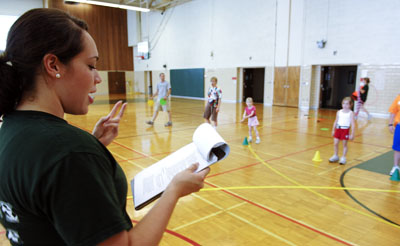
Goodway highlighted an example of SKIP in action: “They can pick up the ball and practice the word ‘ball’ or the sounds ‘ba, ba, ba.’ They can throw the ball at a picture and aim for the letter B. That sequence focuses on an essential motor skill — throwing — and literacy in a preschool program.”
In this way, Goodway suggests, we can have active schools, not just active physical education classes. If we focus less on getting activity only in the gym and more on adding it to active classrooms and active libraries, it can motivate change that can be life-changing.
Vazou’s work on movement and learning is based on educational and psychological theories named embodied learning and cognitive stimulation theory. While kids can learn the skills in a gym class setting, they can also be applied in the classroom. Kids can read the word “jump” in a card and then perform the move to show reading comprehension, for example. Or, to enhance running skills, teachers can set up a true/false game in which the students move to various areas of the room that represent “true” or “false.” These examples are from Vazou’s Move for Thought and Move for Thought PreK–K programs that are freely available to teachers (see sources).
As the country reintroduces the Presidential Fitness Test, Goodway and Vazou broadly say it is too soon to tell if its implementation will be a good or a bad thing. How it is implemented, and how or if it will be changed from decades prior, will be central to what happens next.
“The Presidential Fitness test is a simplistic and easy idea that, magically, the whole country could become fit after reintroducing it. The evidence, however, doesn’t support that. Implementing a test isn’t going to move the needle,” Goodway says. “Improving the health and well-being of our country is a complex problem. It’s going to need complexity to solve the problem.”
They recommend incorporating more movement programs, like Goodway’s SKIP, or Vazou’s Move for Thought.9 The more kids move, the earlier they move, the more ways movement is incorporated into their daily lives, it will benefit them. They also encourage ways to prioritize movement outside of school, making it part of family routines.
“We’re still looking for solutions to make our society healthier. One thing we know is that this approach, the Presidential Fitness Test, is not contributing to the solution,” Vazou concludes. “It’s contributing to the problem.”
Sources:
- United States of America Executive Order 14327. Title 3, Code of Federal Regulations (CFR). 37993 (Published August 6, 2025). https://www.federalregister.gov/documents/2025/08/06/2025-15011/presidents-council-on-sports-fitness-and-nutrition-and-the-reestablishment-of-the-presidential
- U.S. Department of Health & Human Services. (n.d.). “Physical Activity Guidelines for Americans, 2nd Edition.” Current guidelines. https://odphp.health.gov/our-work/nutrition-physical-activity/physical-activity-guidelines/current-guidelines
- Ward, Kim. (September 9, 2024) “Increasing the number of youth in sports could improve health, save $80B.” MSUToday. https://msutoday.msu.edu/news/2024/09/increasing-the-number-of-youth-in-sports-could-improve-health-save-80-billion
- Vazou, Spyridoula, et al. “Psychologically informed physical fitness practice in schools: A field experiment.” Psychology of Sport & Exercise 49 (2019) 143–151.
- Stodden, David F., et al. “A Developmental Perspective on the Role of Motor Skill Competence in Physical Activity: An Emergent Relationship.” Quest, 60(2), 290–306 (2008).
- Ladwig, Matthew, Vazou, Spyridoula and Ekkekakis, Panteleimon. “‘My Best Memory Is When I Was Done With It:’ PE Memories Are Associated with Adult Sedentary Behavior.” Translational Journal of the American College of Sports Medicine. 3(16): 119–129 (2018).
- Brian, A., Goodway, J., Logan, J., & Sutherland, S. (2017). “SKIPing with Head Start teachers: Influence of T-SKIP on object control skills.” Research Quarterly for Exercise and Sport, 88(4), 479–491.
- Biancone, T. L. & Goodway, J. D. (2019). “The effects of an integrated early literacy and motor skill intervention on children’s alphabet knowledge, initial sound awareness and fundamental motor skill outcomes.” Presented at the International Consortium for Motor Development Research.
- Vazou, S. “Move for Thought PreK–K.” https://www.moveforthought.org/