By Lauren Knapp & Kim Ward
Since its creation in 2017, the MSU Education Policy Innovation Collaborative has been fueled by a singular motive: to conduct research with consequence.
“EPIC is devoted to the idea that rigorous evidence can strengthen policy decisions for Michigan’s most critical education issues,” said Emily Mohr, EPIC’s managing director. “These lessons can be applied by leaders to improve conditions for the most underserved students and advance efforts toward equitable educational opportunities and outcomes.”
Over the years, EPIC has worked with state leaders to create a targeted research agenda to learn which reform strategies are most effective, where, when and for whom.
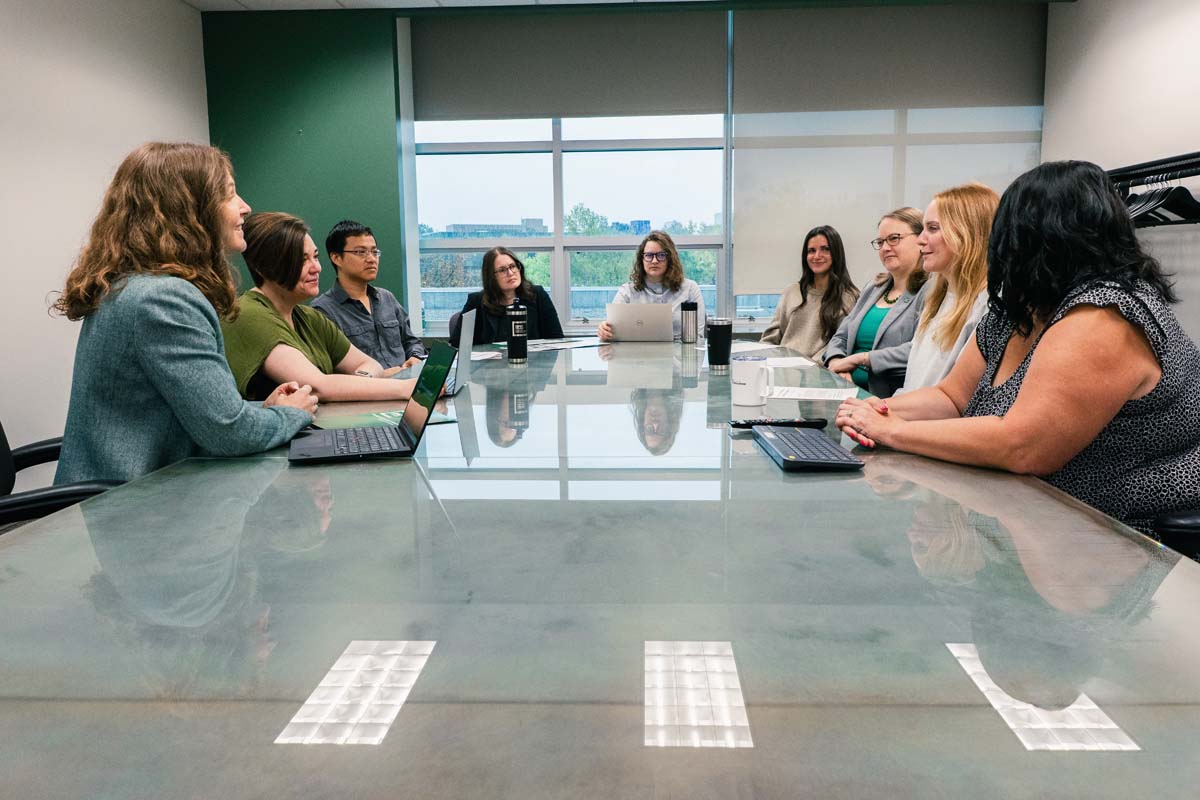
The team, which includes faculty leaders, dedicated staff, dozens of research affiliates and graduate students, focuses on research topics that are high-priority for Michigan, including the educator workforce, early literacy, education funding, school turn-around and more.
At the center of EPIC’s operation are enduring partnerships with key education decision makers, including the Michigan Department of Education; the Center for Educational Performance and Information; the Michigan Department of Lifelong Education, Advancement and Potential; education agencies; and local school districts.
A new era
Now, EPIC is under new leadership: Professor Madeline Mavrogordato took the helm of the center in May 2025.
“I believe the most impactful research is conducted in close partnership with policymakers and stakeholders who are grappling most directly with the issues researchers are seeking to study,” Mavrogordato said. “At EPIC, I look forward to strengthening and building new partnerships that advance evidence-based policy change in Michigan and beyond.”
One of these partnerships is with Kentwood Public Schools, led by Spartan alum and Superintendent Kevin Polston.
Kentwood looks to EPIC for the latest research and evidence to drive their work forward as the district executes its strategic plan, including goals of creating a culture of excellence, cultivating a high-impact, diverse staff and building an educational environment that supports the whole child.
“EPIC is the gold standard for partner-driven research, not just in Michigan, but in the nation,” said Polston, B.A. ‘01 (Social Science – Secondary Education). “Kentwood partners with EPIC because we care about using research to make the best decisions for our students and educators.”
Mavrogordato takes over from Katharine O. Strunk, who stepped down in 2023 to serve as dean for the University of Pennsylvania Graduate School of Education.
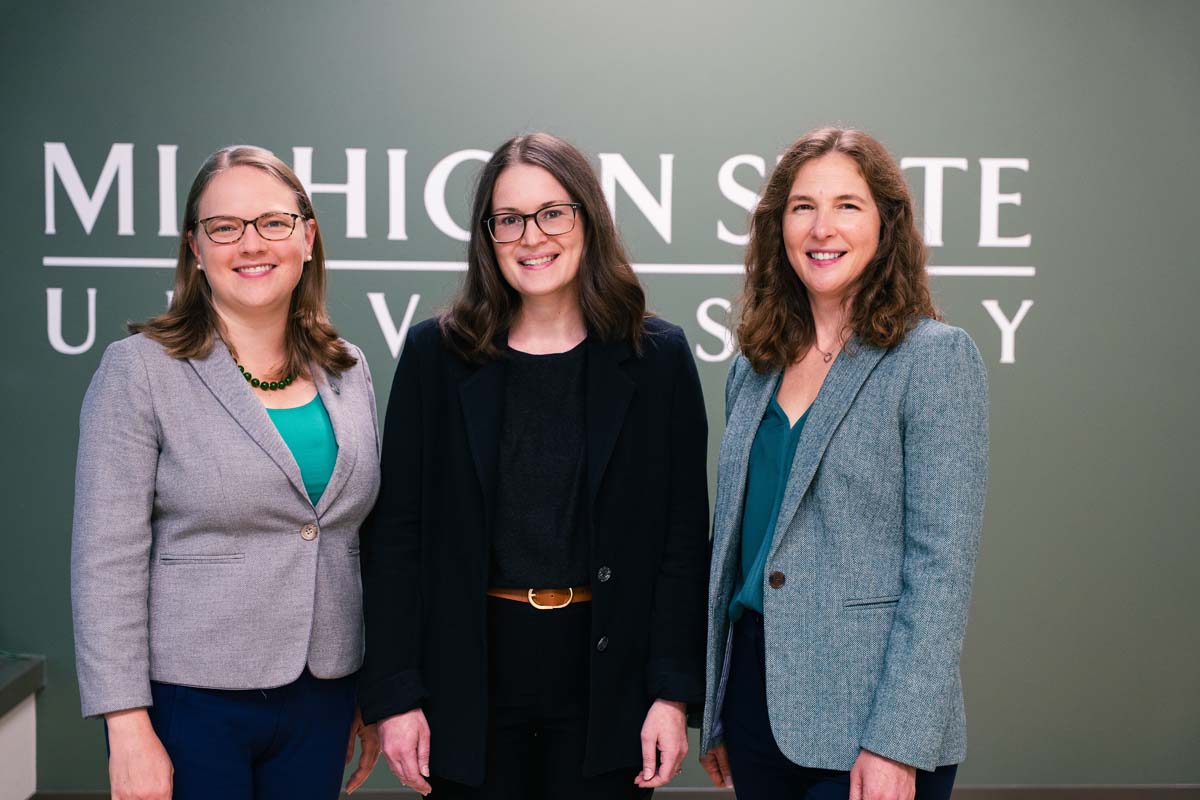
“Dr. Mavrogordato joins an already strong EPIC leadership team, and I am confident in EPIC’s ability to continue partnering with state and local policymakers and practitioners to support critical research needs,” said Strunk. “EPIC’s work remains vitally important at a time when public education is facing unprecedented challenges. I am thrilled that Dr. Mavrogordato and the EPIC team will continue to support Michigan’s leaders and educators as they work to improve outcomes for Michigan’s students.”
Tara Kilbride rounds out the leadership team with Mohr and Mavrogordato. Mohr and Kilbride have been with EPIC since the earliest days, and Kilbride was promoted to associate director in 2025.
Demand & Data
One issue EPIC has researched extensively is the educator shortage, particularly its impact in the state of Michigan.
“We regularly hear that there is a teacher shortage, but arguably this does not manifest the same way in every school district in the state,” Mavrogordato noted. “If we want to generate targeted solutions and use resources wisely, we need to leverage data to enhance policy design and drive the right investments to combat the teacher shortage.”
One way EPIC works to inform policymaking in this area is through the Michigan Teacher Shortage Study, published annually in January since 2022.
The latest report1 found there was recent growth in the supply of Michigan teachers, but there were continued issues with turnover and matching teachers’ credentials with schools’ needs.
In recent years (academic years 2021-2022 through 2023-2024), teachers entered and exited the profession at elevated rates, meaning more instability in the workforce overall.
Select data points from the 2025 report include:
- Teacher trainees with interim or temporary credentials (like substitute permits) held an all-time high of 8% of the state’s public school teaching assignments.
- District-reported vacancy rates were higher for special education than for any other type of teaching position and accounted for 3.2% of all full-time vacancies.
- Many districts reported more than 10% of their special education positions as vacant.
The results are concerning, but the state and MSU are prioritizing ways to change the trajectory.
Reports, like ones developed by EPIC, highlight that Michigan has recently invested over $1.1 billion2 in incentives to attract new teachers — like Grow Your Own programs, or the state’s Future Proud Michigan Educator grants to offset student loans.
EPIC is researching how some of these efforts are working. For example, they are actively engaged in research into Grow Your Own programs (which recruit and retain teachers from local communities). A preliminary report on what they’ve analyzed so far was published in July 2025.3
Teacher Compensation
Despite efforts to increase the number of teachers, issues persist once educators are in the profession.
In August 2025, an EPIC report4 found Michigan ranks 44th among states for average starting teacher pay, down five positions from the 2021-22 academic year. New teachers in Michigan earn approximately $41,600 annually, almost $4,900 below the national average.
Experienced teachers fare slightly better, but Michigan’s overall average salary ranking has also fallen from 16th to 19th nationally, now sitting at $69,100, or roughly $3,900 less than the rest of the U.S.
These declining rankings are driven in part by major policy efforts in other states to increase teacher pay, while Michigan has done little in this area.
At the same time, the wage gap between teachers and comparably educated professionals in other fields is growing wider. Michigan teachers now earn nearly 23% less than other workers with similar levels of education and experience.
There is strong public support for increasing teacher compensation in Michigan. EPIC worked to gather public opinion data and found 75% of Michigan adults support increasing the typical starting teacher salary by a meaningful amount. The public believes starting teachers in Michigan should earn $54,600 on average, or roughly $13,000 more than they earned in the 2023-24 school year, the most recent year for which data are available.
Other efforts to support educators — like expanded professional development and additional pay — show some promise.
EPIC recently partnered with TeachMichigan to evaluate their program to provide top teachers and school leaders in under-resourced schools across the state with professional development and financial support.
That collaboration5 (led by Mavrogordato), found that 50% of participants considered leaving the profession before TeachMichigan.
Now, 95% of participants have remained in their schools.
Preliminary results show that the stipend each TeachMichigan fellow receives brings average teacher compensation in line with other college graduates in the state, and TeachMichigan fellows are more satisfied with their compensation when factoring in their stipend.
“Meaningfully increasing educator compensation is positioning TeachMichigan fellows at the top of their local labor market, thereby removing the monetary incentive to leave and find a position in a more affluent district nearby,” Mavrogordato explained.
Funding History
It‘s not just teacher pay that’s an issue: Dollars simply aren’t stretching as far as they once did inside classrooms. A September 2025 EPIC report6 examined the history of Michigan’s education funding.

“In a nutshell, we are seeing education funding recovery without full restoration,” Mavrogordato explained. “While overall education funding has increased in recent years, bolstered by federal support emerging from the pandemic, statewide per-pupil revenue remains below early-2000s peaks when adjusting for inflation. A larger share of dollars now arrives through restricted funding streams rather than flexible sources, and districts are responsible for a broader set of services reaching a student body with a greater level of need. At the same time, the cost of mandatory benefits has risen, further compressing the share of funding available for classroom salaries, materials, and student supports. In short, Michigan’s schools have been asked to do more with less purchasing power than they had a generation ago.”
Research, from EPIC and beyond, suggests that increased per-pupil funding is linked to “better achievement, educational attainment and lower reliance on social services during adulthood.” Put another way in the funding report: “spending and outcomes are linked.”
The funding report suggests considerations for policymakers that range from indexing core revenue streams to inflation, promoting efficiencies through voluntary shared services, and considering revenue enhancements. At time of writing, where legislation goes remains to be seen.
Research with consequence
“There is more to be done,” said Mavrogordato, “the trends in teacher shortages, pay and other areas are concerning, but we hope we can continue to work with policymakers and legislators to use data to drive positive educational change in Michigan. It’s what our students, educators, and communities deserve.”
And that, EPIC leaders said, is what research with consequence is all about. MSU scholars conduct research that can turn not only the conversation, but also the tide to make transformational change.
It is taking the known challenges and researching what is happening and why to help policymakers and legislators make informed decisions as they develop policy.
It is defining the scope of the issue. Studying the teacher shortage, for example, goes beyond identifying that there is a shortage, but also using research to specify areas of the state particularly impacted, or analyzing if the shortage affects particular grade levels or subject areas more than others.
It is working with superintendents (like MSU alum Polston) and educators to analyze the problem in the areas that will support their day-to-day work in schools and classrooms.
It is finding and showing evidence to help illuminate pathways for change.
And then, it is researching the enacted policies to see if the implementation worked as intended.
And when evidence-based policies, informed by MSU research, positively impact the lives of educators, students, school leaders, caregivers and other stakeholders?
Everyone wins.
About Madeline Mavrogordato
Mavrogordato is known for conducting rigorous and relevant mixed-methods research with and for stakeholders, effectively communicating research to diverse audiences, and translating research into practice. Mavrogordato’s research has been funded by more than $3 million in external funding from agencies such as the Institute of Education Sciences and the Skillman Foundation. Read more.
As of December 2025, Mavrogordato has contributed to more than 25 research/policy briefs and research reports with EPIC scholars.
Sources:
- Kilbride, T., Rogers, S., Moriarty, J. and Powell, T. “Michigan Teacher Shortage Study: 2025 Report.” January 2025. https://epicedpolicy.org/michigan-teacher-shortage-study-2025-report/
- Launch Michigan. April 2025. “Strengthening the Pipeline: Recommendations for Investing in Michigan’s Educator Workforce.” https://static1.squarespace.com/static/602ea1c3e4b8d4663c414ef1/t/680a37d5b51e846241041f90/1745500118817/Launch+Michigan+Strengthening+the+Pipeline+Report+April+2025.pdf
- Moriarty, J., Burns, J. and Okoro, C. “Grow Your Own Teacher Initiatives in Michigan At-A-Glance.” July 2025. https://epicedpolicy.org/gyo-teacher-initiatives-in-mi-at-a-glance/
- Burns, J. and Mavrogordato, M. “Teacher Compensation in Michigan: Recent Trends and Public Opinion, 2025 Update.” https://epicedpolicy.org/teacher-compensation-recent-trends-and-public-opinion-2025-update/
- Hratchian, A. May 26, 2025. “TeachMichigan: A big bet on Michigan’s teachers and leaders.” Crain’s Detroit Business. https://www.crainsdetroit.com/crains-content-studio/fixing-michigans-teacher-shortage-crisis
- 6. Burns, J. and Guzman, M. September 2025 “Funding Michigan’s Future: Three Decades of School Finance and the Policy Questions Ahead.” https://epicedpolicy.org/funding-michigans-future-k-12-finance-report/``