
Continuing the 2024-25 Michigan EPFP Year in Washington, D.C.
Springtime in the nation’s capital is always hectic. Between visitors flocking to Washington, D.C. for the National Cherry Blossom Festival, hordes of middle and high schoolers descending on the National Mall to learn about American history during their spring breaks, and locals taking advantage of the warmer, sunnier post-winter weather, people seem to be everywhere during this period. This year, spring also brought copious policy activity in Washington, D.C., including lawmakers racing to finalize a spending bill “hours before a government shutdown,” “a flurry of executive orders” and related litigation accompanying President Donald Trump’s return to the White House, and administrative efforts seeking to “shut down the entire federal Department of Education” and “gut and remake” the federal government writ large (AP; U.S. News & World Report; BBC; The Seattle Times). Undeterred by this frenetic action bordering on chaos, this March, the Michigan Education Policy Fellowship Program (EPFP) co-coordinators from the Office of K-12 Outreach and the 2024-25 Michigan EPFP Fellows, including 33 education professionals from local school districts, the Michigan Department of Education, the Michigan Department of Lifelong Education, Advancement, and Potential, intermediate school districts and regional educational service agencies, education non-profits, advocacy groups, and colleges and universities, traversed to America’s capital for the 2025 Washington Policy Seminar (WPS).
For 61 years, this three-day conference, hosted by the Institute for Educational Leadership (IEL), has offered EPFP cohorts from across the nation the opportunity to continue their learning about education policy, leadership, and networking in Washington, D.C. Centrally, the annual WPS helps participants think about these threads in the federal context, given EPFP sites’ robust fall and winter focus on local, state, and regional education ecosystems via half- and full-day professional learning sessions, Fellow-led Learning Team research projects and presentations on topics of interest, and a Regional Leadership Forum with peer cohorts from New York and Pennsylvania built around lessons from the Battle of Gettysburg and U.S. Army War College. Additionally, each year, the WPS provides the chance for EPFP Fellows from Michigan and elsewhere to connect with invested peers to learn about what is and what is not working concerning education policy in other states; develop their personal and professional networks; observe policymaking processes they have studied back home firsthand; advance essential skillsets via expert talks and action-oriented breakout sessions featuring thought leaders currently or formerly affiliated with the U.S. Department of Education, innovative think tanks and research organizations like the Education Commission of the States and the Education Trust, and various colleges and universities; and gain further inspiration for the remaining months of their EPFP experience and future policy work from D.C. and its awe-inspiring seats of government, monuments, and institutions.
To launch the 2025 WPS, EPFP Fellows from California, Georgia, Michigan, and Mississippi gathered alongside invited policy-minded guests from a litany of other states on Monday, March 17th, at the conference hotel – the DoubleTree Washington DC – Crystal City. Following a welcome to the WPS, an overview of the program’s goals for the next three days, and an acknowledgment of Michigan EPFP’s 50th anniversary this year from Eddie Koen, President of the IEL, and Dr. Michelle Lessly Blackburn, Senior Policy Manager for the IEL, each state had the chance to announce its presence with a roll call chant. In anticipation of the start of March Madness after the conference’s conclusion, the Michigan EPFP Fellows, including some folks with educational or familial ties to institutions other than MSU, initiated a booming “Go Green! Go White!” chant. While each state had a creative approach to the welcome, in our biased eyes, the Michigan EPFP Fellows stood out with their enthusiasm and green-and-white pom poms.
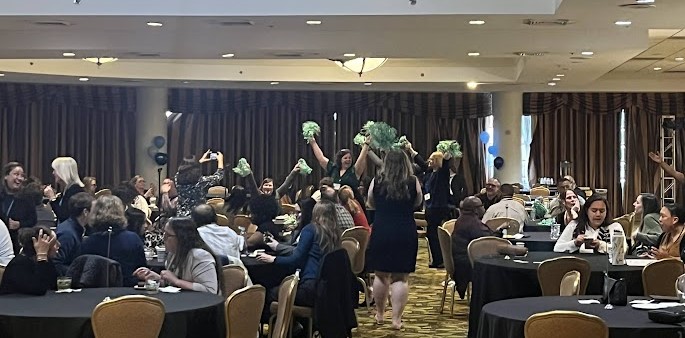
Michigan EPFP Fellows making their MSU pride clear
Rapport-building and celebration aside, day one of the WPS moved into the education policy content that brought everyone to Washington, D.C. First, the attendees observed an opening plenary titled “The Federal Role in Education” featuring Michelle Austin, Senior Vice President and Managing Director for GMMB; Augustus Mays, Ed Trust’s Vice President for Partnerships and Engagement; and Michael J. Petrilli, President of the Thomas B. Fordham Institute. As an important framing piece of the WPS, this panel helped Fellows understand the evolution of the federal government’s place in education policy and how the Trump Administration is likely to challenge recent approaches to governance. From there, the conference participants moved into breakout groups to engage in a case study concerning AI in schools. During this activity, Fellows were asked to role-play as policy analysts studying a district’s context, considering challenges and opportunities connected to emerging educational technologies, providing resultant recommendations for how to capture the upsides of AI in education while minimizing its downsides, writing a policy memo detailing their conclusions, and presenting their takeaways to others. Beyond giving folks time to dig into this pressing policy topic, the activity helped WPS attendees refine essential policymaking competencies and skills. Finally, to wrap up the first day of the 2025 WPS, the plentiful conference attendees gathered for an opening reception to debrief their initial takeaways from the program, meet educational professionals from other states, and identify some wonderings to address during their remaining time in Washington, D.C.

WPS attendees listen to an education policy panel
Day two of the WPS started with a networking breakfast where EPFP Fellows were asked to engage with peers who work in similar roles. In addition to providing some fuel for the long day of education policy, the meal afforded folks a low-stakes window to compare experiences across states. After that, the group engaged with another plenary, this time on “Accountability Frameworks in Policy: Understanding Educational Outcomes from A State and Federal Perspective.” This panel included facilitator Michael DiNapoli, Director of Federal Policy for the Learning Policy Institute; Nicholas Munyan-Penney, Assistant Director of P-12 Policy for EdTrust; Shital Shah, Former Senior Advisor to the Secretary & Director of Strategic Partnerships for the U.S. Department of Education; and Claus von Zastrow, Senior Policy Director at the Education Commission of the States. Among other things, it emphasized some changes to federal education policy from the new administration and considered how state education leaders might take advantage of this moment to drive various reforms to school accountability. Then, the conference split up into a series of workshops spread across two time slots where Fellows could delve into topics like “Developing Policy Strategies to Support Community Schools,” “Empowering Youth Voice and Leadership: Strategies for Meaningful Engagement,” “Ethical Leadership,” “Interagency Collaborations to Support Student Needs,” “The Impact of AI on Education Policy,” “Best Practices for Developing and Implementing Rural Education Policy,” “Career-Focused Mentoring: Guiding Youth Through Exploration and Transition,” “Policy Solutions to Support Post-Secondary Pathways,” “Sustainable Funding After ESSER,” and “The Role of Coalitions in Achieving Shared Policy and Advocacy Goals.” To conclude the day, the Michigan EPFP faction broke off from the rest of the conference to head to the U.S. Capitol for a behind-the-scenes tour and meeting with Jacob Courville, Director for Federal Relations for MSU. Concerning this latter program element, the group met in the U.S. Capitol Visitor Center to discuss lobbyists’ role in the policymaking process, how MSU is responding to federal policy changes, and how Fellows can connect with their representatives to advocate effectively as they continue the EPFP experience.
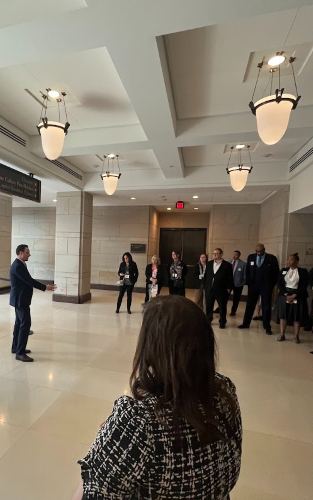
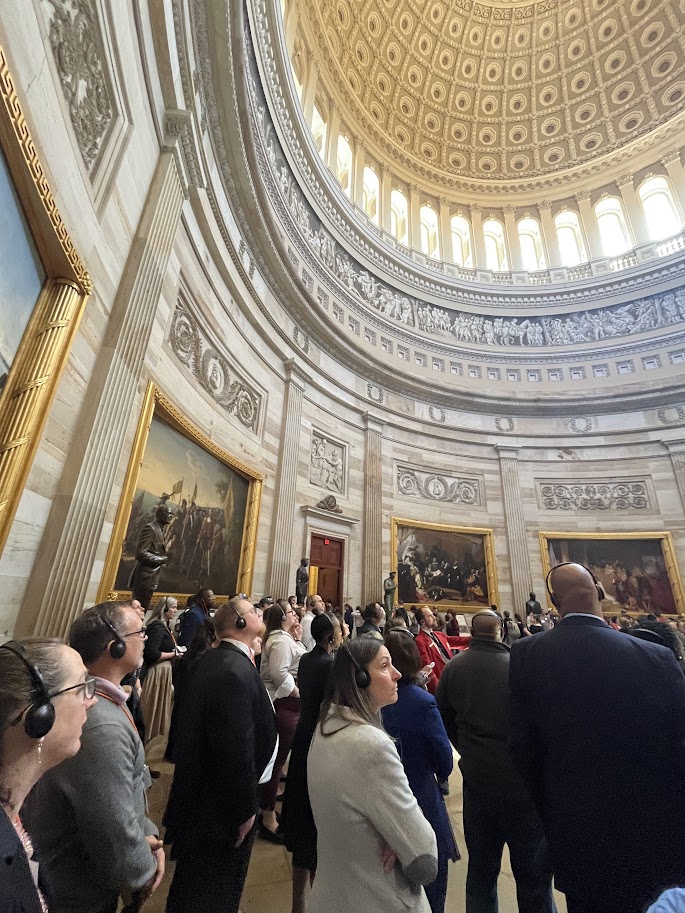
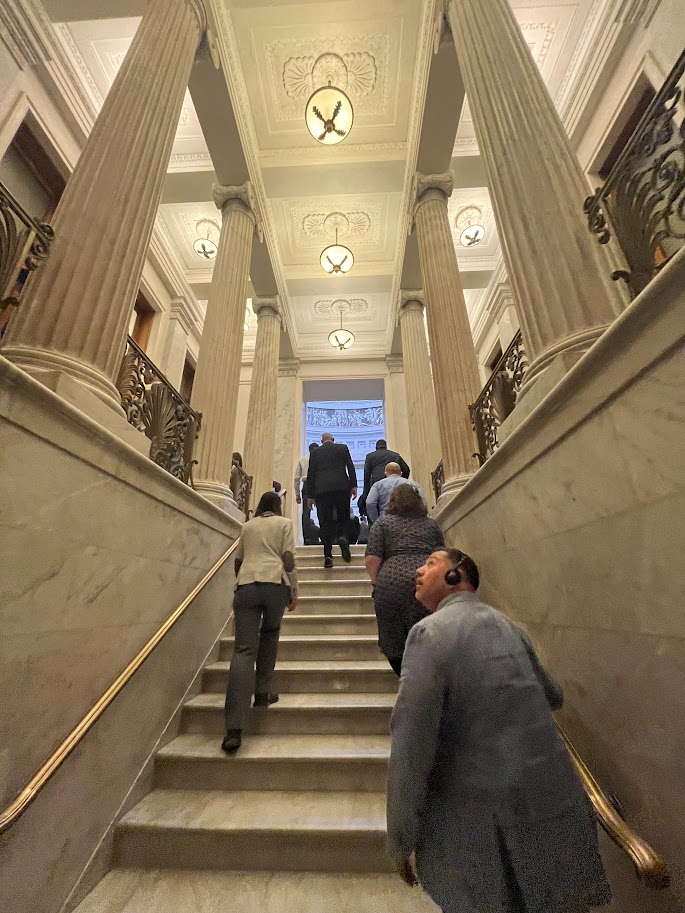
Snapshots from Michigan EPFP’s Hill Day
To wrap up the 2025 WPS, program attendees gathered on day three for a networking breakfast again at the conference hotel. For this meal, everyone was grouped by region to facilitate some conversations about how actors geographically near them are approaching education policy. Following that, the participating Fellows returned to assessing Congress’ role in developing and passing education laws via a plenary from Danica Petroshius, Managing Principal at Penn Hill Group, on “Policy, Politics, & Procedures Inside Congress.” Specifically, this talk walked Fellows through Penn Hill’s “5 Ps” of education advocacy and understanding legislative efforts – people, policy, process, politics, and practice. Crucially, this presentation gave the Michigan EPFP cohort a framework to better understand why certain pieces of legislation pass and others stall. With that, it helped bridge Michigan Fellows’ experience on Capitol Hill and their future plans for advocacy. Penultimately, the group worked through a meaning-making activity in small groups designed to help everyone reflect on what they learned at the WPS, what wonderings they still have about federal education policy, and how they will share their insights with peers at their sponsoring organizations and in their communities back home. Finally, the experience closed with a plenary on “The Future of Work & What It Means for the Frontline.” Here, Chike Aguh, Senior Advisor at Harvard’s Project on Workforce, shared some insights with the group on how the demands of schooling might change over the next few decades and the need for educators to shrink the gaps between the current state of schools, policymakers, and future trends. In doing so, he provided the Fellows with a chance to consider all they learned and what is next for them.
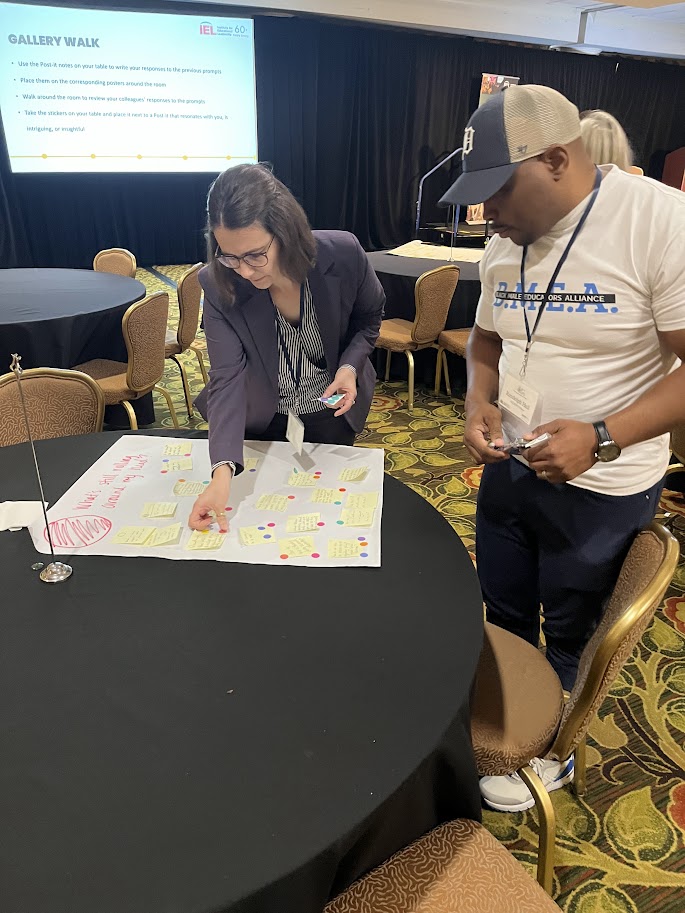
Meaning-making at the 2025 WPS
As was true of previous iterations of the Washington Policy Seminar, this year’s conference delivered an up-close look at federal education policy, an engaging opportunity for Michigan EPFP Fellows to develop essential knowledge and skills, a unique view of Washington, D.C., and space to link up with like-minded peers from across the nation (March 2021, March 2022, March 2023, and March 2024 In Focus newsletters). Over the next few months, the 2024-25 Michigan EPFP cohort will have plenty of opportunities to build on their learning via four remaining Learning Team presentations on salient education policy topics, a Day at the Michigan Capitol in May, and a closing session in June that will also serve as a celebration of Michigan EPFP’s 50th anniversary. From there, Fellows will be tasked with taking their learning to the field and hopefully positively shaping education policy in their local contexts, across Michigan, and nationwide. Readers interested in learning more about the Michigan Education Policy Fellowship Program and its associated suite of experiences in Washington D.C., Pennsylvania, and Lansing can reach out to Michigan EPFP Co-Coordinator Tyler Thur by email at thurtyle@msu.edu.
