Jump to HeaderJump to Main ContentJump to Footer
Michigan State University
College of Education
  • Strategic Plan
  • Resources
  • People Directory
  • Alums
  • Contact
  • Give

College of Education

  • About
    • Mission & History
    • Strategic Plan
    • Points of Distinction
    • Leadership
    • Academic Departments, Centers, Institutes & Offices
    • Faculty and Staff Directory
    • Inclusion & Diversity
    • Outreach Efforts
    • Buildings & Facilities
    • Career Opportunities
    • Ways to Give
    Dean Jerlando Jackson stands in front of a sign that reads Michigan State University.

    Meet Dean Jackson

    Meet Dean Jerlando F. L. Jackson
  • |
  • Academics
    • Majors & Degree-Granting Programs
    • Undergraduate Programs
    • Master's Studies
    • Doctoral Studies
    • Online Studies
    • Graduate Certificates & Specializations
    • Undergraduate Student Support
    • Graduate Student Support
    • Assistantships
    • Scholarships
    • Accreditation
  • |
  • Certifications
    • Become Certified or Add an Endorsement
    • School Psychologist Certification
    • Student Affairs Office
    • MSU Academic Programs Catalog
    • MSU Office of Accreditation, Assessment, Curriculum & Compliance
    Individual bikes on MSU's campus

    Educator Preparation & Accreditation

    Explore our efforts
  • |
  • Research
    • Office of Research Administration
    • Centers & Institutes
    • Student Research Opportunities
    • Research & Award News
    • Faculty Directory
    Aerial view of a driver in a race car

    Cooler, safer race car tech via MSU study

    Read about our research
  • |
  • Outreach
    • Policy
    • K-12 Schools & Districts
    • Urban Areas
    • International Areas
    • Alumni
    • Institute for the Study of Youth Sports
    • Office of Access & Community Engagement
    • Office of International Studies in Education
    • Office of K-12 Outreach
    • All Offices, Centers & Institutes
    oise

    40+ years of the Office of International Studies

    Explore our impact
  • |
  • News & Events
    • News
    • New Educator Magazine
    • Subscribe: ReviewED Newsletter
    • Events Listing
    Ann Austin poses for the camera in front of a bookshelf

    Celebrating: Ann E. Austin

    Austin named Fellow of American Association for the Advancement of Science
College of Education
  • About
  • Academics
  • Certifications
  • Research
  • Outreach
  • News & Events

< About

  • Mission & History
  • Strategic Plan
  • Points of Distinction
  • Leadership
  • Academic Departments, Centers, Institutes & Offices
  • Faculty and Staff Directory
  • Inclusion & Diversity
  • Outreach Efforts
  • Buildings & Facilities
  • Career Opportunities
  • Ways to Give
Dean Jerlando Jackson stands in front of a sign that reads Michigan State University.

Meet Dean Jackson

Meet Dean Jerlando F. L. Jackson

< Academics

  • Majors & Degree-Granting Programs
  • Undergraduate Programs
  • Master's Studies
  • Doctoral Studies
  • Online Studies
  • Graduate Certificates & Specializations
  • Undergraduate Student Support
  • Graduate Student Support
  • Assistantships
  • Scholarships
  • Accreditation

< Certifications

  • Become Certified or Add an Endorsement
  • School Psychologist Certification
  • Student Affairs Office
  • MSU Academic Programs Catalog
  • MSU Office of Accreditation, Assessment, Curriculum & Compliance
Individual bikes on MSU's campus

Educator Preparation & Accreditation

Explore our efforts

< Research

  • Office of Research Administration
  • Centers & Institutes
  • Student Research Opportunities
  • Research & Award News
  • Faculty Directory
Aerial view of a driver in a race car

Cooler, safer race car tech via MSU study

Read about our research

< Outreach

  • Policy
  • K-12 Schools & Districts
  • Urban Areas
  • International Areas
  • Alumni
  • Institute for the Study of Youth Sports
  • Office of Access & Community Engagement
  • Office of International Studies in Education
  • Office of K-12 Outreach
  • All Offices, Centers & Institutes
oise

40+ years of the Office of International Studies

Explore our impact

< News & Events

  • News
  • New Educator Magazine
  • Subscribe: ReviewED Newsletter
  • Events Listing
Ann Austin poses for the camera in front of a bookshelf

Celebrating: Ann E. Austin

Austin named Fellow of American Association for the Advancement of Science
  • Strategic Plan
  • Resources
  • People Directory
  • Alums
  • Contact
  • Give
Education > Teacher Preparation Program >

Global Educators Cohort Program

aladeimi-shireen-aside-600x717

Director Shireen Al-Adeimi
Email: aladeimi@msu.edu
Phone: (517) 353-5091
Michigan State University
Erickson Hall
620 Farm Lane, Room 324
East Lansing, MI 48824

morley-alyssa-aside-600x717

Coordinator Alyssa Morley
Email: morleya2@msu.edu
Phone: (517) 353-5091
Michigan State University
Erickson Hall
620 Farm Lane, Room 330
East Lansing, MI 48824

Follow @msugecp
Michigan State University

Programs

  • Undergraduate Programs
  • Master's Programs
  • Doctoral Programs
  • Online Programs

Academic Departments

  • Counseling, Educational Psychology & Special Education
  • Educational Administration
  • Kinesiology
  • Teacher Education

For Students

  • Graduate Support
  • Undergraduate Support
  • Scholarships
  • Assistantships

For Faculty & Staff

  • Communications
  • Data & Analytics
  • Human Resources
  • Policies, Committees & More
  • Tech Services

Our College

  • Office of the Dean
  • Imagin[ED] 2030 Strategic Plan
  • Mission
  • Directory
  • Centers & Institutes
  • Accolades & Awards
  • Rankings
  • Subscribe to our Newsletter
  • "New Educator" Magazine
  • News
  • Jobs

Contact us

(517) 355-1734

Address

Michigan State University College of Education 620 Farm Lane East Lansing, MI 48824

Releases and Statements

Follow Us

  • Visit our Facebook page
  • Visit our page on X
  • Visit our Instagram page
  • Visit our LinkedIn page
  • Visit our YouTube page

If you're having accessibility issues, please let us know.

Know More: Campus Safety Information and ResourcesTransparency Reporting: Budget & Salary/Compensation
Michigan State University
  • Contact Information|
  • Site Map|
  • Privacy Statement|
  • Site Accessibility|
  • Call MSU: (517) 355-1855|
  • Visit: msu.edu|
  • Notice of Nondiscrimination|

SPARTANS WILL|© Michigan State University|

Read: Newsletter
View Our Blog

Global Educators Cohort Program

The Global Educators Cohort Program (GECP) prepares future teachers to develop a critical, justice-oriented stance that enables them to foster students’ understanding of and engagement with complex global issues. 

Small classes, a cohort model and a tailored set of courses provide GECP students with opportunities to grow as global educators and develop a professional learning community that extends beyond their time at MSU.

Beyond academics, GECP is also amplified by co-curricular experiences. Some of our opportunities in recent years included:

  • Social gatherings, including pizza/ice cream parties, potlucks and welcome/graduation celebrations
  • Field trips to locations around Michigan, including Dearborn
  • Group study sessions
  • Presentations from students and alums about their GECP experiences
  • and more!

Learn about GECP from Program Coordinator Alyssa Morley:

Program Highlight: Dearborn Trip

GECP students annually participate in the Dearborn Learning Experience. During a two-day visit to Dearborn, Michigan, students deepen their global competence through a multi-day experience in a culturally and linguistically diverse community. Through classroom observations, guided museum tours and cultural experiences, students learned about Dearborn schools’ and teachers’ efforts to engage Arab American culture, experiences and perspectives through culturally sustaining practices. In this photo, a GECP student and leader group poses while visiting a Dearborn elementary school.

teachers in a classroom in dearborn

GECP Curricular and Co-curricular Program Components

The Global Educators Cohort Program (GECP) gives future educators the tools they need to teach with a global view and to make an impact in today’s classrooms, which are increasingly culturally diverse. Through social and educational experiences, MSU’s Global Educators are prepared to help young people think about themselves as citizens and stewards of the world around them.
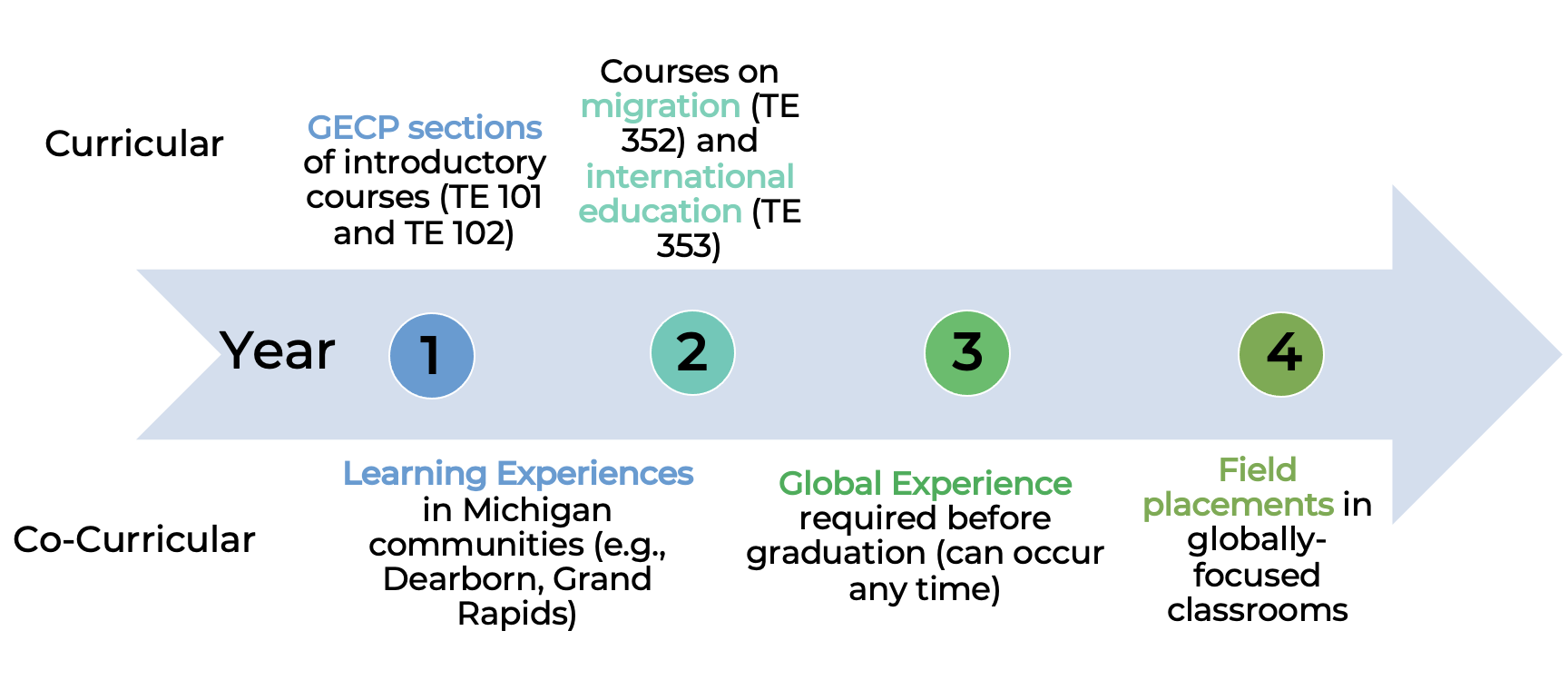
arrow flow chart showing the years and experiences associated with each year

Student Testimonials

Why should you join GECP? It helps you gain a better understanding of the increasingly diverse educational system in America and around the world. The challenging coursework prepared students for a career in education, and the course content helps Spartans analyze their contributions to the world.

– Matt White (Alumnus)

Growing up as a Korean-American, I’ve always been interested in learning about education all over the
world. I was so excited to hear MSU provides a cohort like GECP. I’ve learned so much about myself in TE 101 and in the GECP program. Through this, I was able to grow more passionate about teaching and even challenge myself to take on a leadership position for something I am passionate about… I want to bring more to the table to grow our GECP community, and to share the passion that I have found through GECP with other GECP students.

– Hannah Yoon, Class of 2025

I joined GECP because I want to teach abroad and work in multilingual classrooms. Additionally, I want to be able to create a globally informed educational setting for my students.

– Elizabeth Tweadey, Class of 2022

Growing up, my family couldn’t afford to travel, so I always felt like I was lacking in cultural knowledge and experiences. I joined GECP so I could gain these experiences in college and have the opportunity to learn about various cultures and engage with individuals with different cultural backgrounds than my own.

-Grace Steele, Class of 2022

Being a part of GECP gave me the unique opportunity to participate in my teacher education program within a smaller network in College of Education. This community included classmates and faculty who were similarly enthusiastic about global education but were also willing to challenge my perspectives to develop my critical thinking skills around pedagogy. The program ultimately provided the confidence I needed to pursue a career teaching abroad, and a network I can still rely on today.

-Taylor Sandweg, Class of 2015, Teacher at Maples Elementary in Dearborn
 

Frequently Asked Questions

What is GECP?

GECP students will develop a critical stance that enables them to foster students’ understanding of and engagement with complex global issues. They will develop this through:

  • Analyzing how historical/cultural production of knowledge and power has shaped education systems and students’ experiences globally
  • Reflecting on their own positionality within complex global systems and structures that perpetuate inequality
  • Challenging structures, assumptions, and attitudes in their context  
  • Developing pedagogical strategies and approaches for incorporating critical engagement with global issues into their teaching 

Cohort Community

Within GECP, you will connect with fellow Spartans committed to teaching with a global, justice-oriented stance.

Faculty Expertise

In small classes with your fellow cohort members, learn from renowned faculty with a diverse set of expertise in their respective fields.

A Different Lens

Throughout GECP and co-curricular experiences, you will be challenged to critically analyze complex global structures and their role in education.

Who can join GECP?

Students join GECP in their first year (or as "first-year students"), and in their first two years, they take four specialized global education courses as a cohort. 

Once they join MSU’s Teacher Preparation Program in Year 3, GECP students have opportunities to apply what they learned through globally focused field placements and internships.

How can I apply to join GECP?
  1. Apply to MSU from your senior year of high school and on.
    1. Obtain admission to Michigan State University and indicate your intention to complete a teacher certificate in elementary or secondary education. Information on financial aid for students can be found on the Office of Financial Aid homepage.
  2. After acceptance to MSU, submit a supplemental application to the Global Educators Cohort Program. GECP applications are due after orientation and before the start of your first year at MSU.

The Global Educators Cohort Program is a specialized program within the Teacher Preparation Program at Michigan State University. GECP students must therefore complete the same requirements as any Teacher Education student at Michigan State University. GECP simply provides added special emphasis in international/global themes.

When you complete GECP, you will graduate from Michigan State University with a degree in Teacher Education and you will be eligible for teacher certification both in Michigan and, often with little or no extra requirements, in many other U.S. States.

Do you offer specialized classes?

In Year 1, coursework is focused on developing students’ understanding of the U.S. education system in global context (TE 101: Social Foundations of Justice and Equity in Education and TE 102: Pedagogy and Politics of Justice and Equity in Education). In Year 2, GECP students continue to cultivate global understandings and skills through coursework on migration and education (TE 352: Migration & Education) and international education (TE 353: International Education).

What are the requirements for the GECP?

Students must enroll in GECP-designated sections for all courses. Descriptions can be found on the MSU Course Description website.

  • TE 101 (GECP section): Social Foundations of Justice and Equity in Education – 3 credits
    • How can we reflect critically on our own individual positionalities and connect these to institutional and ideological systems that exist within, and extend beyond, the United States?
    • How do school structures and practices create and reproduce systems of power and privilege through their intersections with other social institutions and policies?
    • How can we work as change agents and co-conspirators toward social justice and abolitionist transformations in schools and society, both domestically and globally?
  • TE 102 (GECP section): Pedagogy and Politics of Justice and Equity in Education – 3 credits
    • How do socio-political climates impact teaching and learning at interpersonal, institutional, national, and global levels? 
    • How do youth and teachers engage in activism to combat social and institutional inequities?
    • How can critical pedagogies be used to create and nurture more humanizing and justice-oriented teaching and learning?
  • TE 352: Migration & Education – 3 credits
    • How do educational institutions, communities, and families respond to the academic, linguistic, social, and cultural needs and possibilities of immigrant children and youth?
    • In what ways do values, beliefs, and systems surrounding citizenship, belongingness, and immigration underpin educational policies and practices?
    • How do immigrants and refugees in schools and communities negotiate and respond to educational policies and social structures as they craft their own identities and sense of belonging?
       
  • TE 353: International Education – 3 credits
    • How are conceptions of education rooted in specific cultural contexts and reflected in the structure of education systems, teachers’ pedagogical approaches, and students’ classroom experiences? 
    • How do international education projects respond to, erase, and/or complicate the complexities of educational experiences?
    • What does it mean to apply global perspectives in education?
What is the purpose of the Global Experience?

As a global educator, you are learning to develop skills and understandings that will support your future work with students. The Global Experience Requirement is not about going to a new place and being a tourist–it involves a deeper level of engagement. A global experience pushes you to rethink your own assumptions and to think critically about the role global educators can play in helping all young people develop agency and the knowledge, skills, attitudes, and values to thrive in their future lives and contribute to their communities.  

What counts as a Global Experience? 

The goal of the Global Experience is for you to have an immersive engagement in a setting that will help you develop your ability to engage in contexts and situations that are unfamiliar to you, and to think critically about global issues and how they affect education. The Global Experience is purposeful and carried out with intent–it is not tourism or charity work. 

To meet the Global Experience Requirement, an activity must involve:

  1. A global focus – Global could involve travel outside the U.S., but you can also have a global experience in East Lansing by engaging with a community organization or group at MSU focused on a global issue.
  2. Sustained engagement – Global experiences involve sustained participation in the life of a community. You might do this through an immersive Education Abroad experience. If you complete your global experience locally, you should document at least 40 hours of engagement with an organization or group focused on global issues.
  3. Active participation – Global engagement involves doing something. You cannot meet this requirement simply by attending lectures. To meet the requirement, you’ll need to identify an opportunity that allows you to actively engage in a community, whether that is at home or abroad.
  4. Reflection – Throughout your global experience, you are encouraged to reflect on how the experience is challenging your own assumptions and to think critically about the role global educators can play in helping all young people develop agency and the knowledge, skills, attitudes, and values to thrive in their future lives and contribute to their communities. You will submit a written reflection upon completion of the Global Experience in order to have your experience certified by the GECP Program Coordinator. 

Once you have identified an activity that meets the criteria above, you must seek approval from the GECP Program Coordinator prior to beginning the activity/engagement.

Many GECP students are excited to participate in an Education Abroad experience, and you certainly can do that to fulfill your Global Experience requirement. MSU hosts many Education Abroad programs. Many programs are going to be up and running again this year, and you can learn more on the Office for Education Abroad website. If you are engaged in an international activity that is not an Ed Abroad program, please check with the GECP Program Coordinator to see whether it meets Global Experience Requirements. 

You can also have a Global Experience without leaving the U.S. Here are a few local activities that you could engage in to fulfill the Global Experience Requirement:

  1. Participate in an activity like the Ubuntu Dialogues Virtual Student Dialogues. This opportunity, hosted by MSU, gives you a chance to interact with university students in South Africa.
  2. Volunteer at an organization serving immigrants, refugees, or migrant students, such as: Refugee Development Center, New Americans Southeast Michigan, or the CAMP program
  3. Volunteer in a globally-focused activity at a K-12 school in the Lansing area.
  4. Participate in a globally-focused registered student org. For example, become an Intercultural Aide.
  5. Participate in a program like the MSU Dialogues or LATTICE.
  6. Another activity that you identify and discuss with the GECP Program Coordinator. 

The GECP Program Coordinator will advertise additional opportunities as they come up, and you can always check to see if something you’re thinking about will fulfill the requirements.

GECP Students’ Global Experience Examples

  1. Co-creation of a podcast series with students in Yemen
  2. Participation in a virtual exchange with students in the Netherlands, Belgium, Germany, & France
  3. Volunteering with refugee-background youth through Lansing’s Refugee Development Center
  4. Participation in a reciprocal exchange program with students at the University of Cape Coast, Ghana
What are some of the details of the internship?

GECP interns fulfill their field experiences in global placements. Global placements are Michigan classrooms where either the school, teacher, or student demographics meet the program’s definition of a global placement.

To fulfill the global internship requirement for GECP, students’ field placements must meet one of the three criteria. The GECP Coordinator can support processes of validation for individual schools.

  1. School indicates a global focus in their mission statement or emphasized school-wide goals. If school does not indicate a global focus, the mentor teacher’s global stance, training, and/or practices in specific classroom placements indicate a global focus.
    • Validate with the school website and/or discussion with district administrators.
  2. Student demographics of school and/or classroom placement indicate a global focus.
    • Validate through MI School Data. Treating multilingualism as a proxy for multiculturalism, a global focus can be indicated by more than 50% of the school population labeled as ‘English Language Learner.”
  3. School has a school-wide language immersion program.
    • Validate with the school website and/or discussion with district administrators.

Want to learn more about the Teacher Preparation Program? Start here.

Additional Frequently Asked Questions (FAQs)

Question: How can I apply to GECP?

Once accepted to MSU, students must complete the GECP Application located in the “Applying to GECP” section. Students will hear back from the review committee within 2-4 weeks of submission.

Question: How can I complete my Global Experience?

Students may complete the Global Experience through participation in activities such as, but not limited to, MSU programs (i.e. MSU Dialogues), education abroad, or globally-focused volunteering. Read more about the requirements for the Global Experience in the “Program Requirements” section.

Question: Is GECP an option for elementary and secondary teacher preparation students?

Yes! GECP is open to future teachers across multiple levels of education and disciplinary focus. In GECP, students have a chance to interact with other future teachers who are specializing in a range of areas–from political science to mathematics to early childhood education. Many cohort students mention appreciating this chance to get to know future teachers across diverse disciplines.

Question: How many classes are required for GECP? 

GECP classes are often students’ favorite part of the program. Four GECP courses are required. Typically, students take two introductory courses in their first year (TE 101 and TE 102), and for these classes, they are in special GECP sections. The other two required GECP courses are TE 352 (Migration & Education) and TE 353 (International Education).

Question: What types of careers do GECP students have?

Many GECP alumni become classroom teachers in the United States or other settings. Because GECP students are well-prepared to work with culturally diverse learners, they often find employment in schools with a high population of transnational students. Beyond teaching, GECP students have found careers working in international education or in the non-profit sector.

Question: Where can I learn more?

Learn more about GECP from former program leaders and alumni in this 2020 video (filmed pre-COVID-19):

Message from the Director

The Global Educators Cohort Program strives to prepare future teachers for the classroom by helping them develop critical stances that guide their everyday instructional decisions and interactions with students, families, and communities. We view commitments to social justice as a lifelong process that involves deep engagement with diverse knowledge, as well as critical self-reflection in pursuit of building principled stances that guide instructional practices and shape students’ school-based experiences. 

To build such justice-oriented, critical stances, we provide a set of engaging courses that expand pre-service teachers’ existing worldviews and knowledge; interrogate how global systemic and structural systems shape the lives of students; and connect global and local struggles as well as pathways for change. 

In addition to learning with and from faculty who are experts in their fields, GECP students will have multiple opportunities to connect and build relationships with their peers. We offer in- and out-of-class experiences that connect GECP peers with one another, including:

  • Cohort experiences such as a trip to Dearborn, MI
  • Opportunities to learn from guest speakers
  • Visits to museums
  • Social events
  • Peer and alumni presentations
  • And many more experiences that bring together members of the GECP program, both faculty and students!

As director, I’m excited to work with GECP Coordinator Dr. Alyssa Morley, GECP faculty, and the GECP Advisory Board: Dr. Alex Allweiss, Dr. Lucia Cardenas Curiel, Dr. Scott Farver, Dr. Jungmin Kwon, Dr. Lynn Paine, and Dr. Bethany Wilinski. 

If you have any questions about GECP, please don’t hesitate to reach out to us!

Shireen Al-Adeimi, Ed.D.
Assistant Professor & GECP Director
Teacher Education Department, College of Education
Michigan State University