Jim Bibbs died on October 10, 2026. Bibbs worked as a professional aide in the Department of Kinesiology from December 2002 to April 2003 where he taught physical activity classes.
Beyond his work with the Department of Kinesiology, Bibbs was the head coach of MSU track and field. According to MSU Athletics, when hired in 1977, Bibbs was the first Black head coach at MSU and the first Black track and field head coach in the Big Ten. Bibbs eventually became the longest-tenured coach in MSU track and field program history.
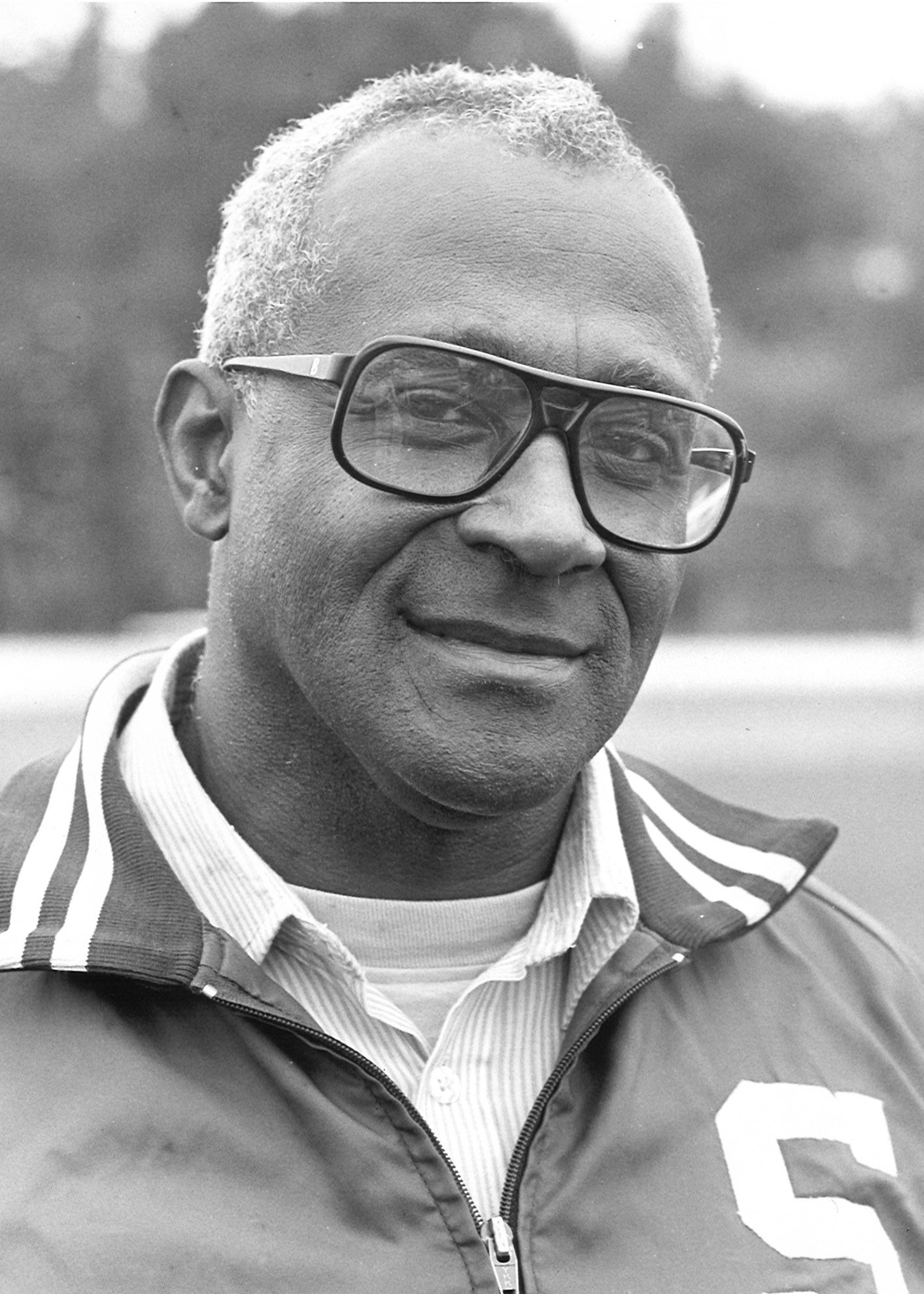
In 2010, Bibbs was inducted into the Michigan State Hall of Fame. He was also inducted into the U.S. Track & Field and Cross Country Coaches Association (USTFCCCA) Hall of Fame in 2015. Throughout his remarkable coaching career, Bibbs’ athletes won numerous championships and honors and broke world records, showcasing his excellence as a coach.
Kinesiology Professor Emeritus Vern Seefeldt recalled his first time working with Bibbs over 50 years ago: “I was working with my graduate student, Michael Marshall, whose baseball contract had just been purchased by the Detroit Tigers. We borrowed a 16mm registration pin camera from the Geography Department because we needed 500 frames per second still-held photos to analyze [the] high-speed movements of baseballs. Coach Bibbs learned that we were using a high-speed motion camera to analyze human motion. He called me and asked, ‘Are you able to film two of my sprinters? They are very good, but I need film to show them how they can be better.’”
Seefeldt was scheduled to work with Bibbs the very next afternoon. Seefeldt worked with Bibbs and his two athletes, Herb Washington and Marshall Dill (both of whom later went on to become Olympic-level sprinters), to film five different trials from the starting blocks, each lasting two and a half seconds. In between each trial, Bibbs offered feedback to his sprinters. Seefeldt said, “His voice was firm, complimentary and corrective. Both sprinters listened intently and seemed eager to try again according to Coach Bibbs’ instructions.”
Seefeldt gave the completed film to Bibbs for review. Seefeldt recalled, “Coach Bibbs called me that afternoon, complimented me about the information on the films, and asked, ‘Are you able to film the sprinters again tomorrow afternoon?’”
Seefeldt went on to film more of Bibbs’ athletes during that season. Bibbs told Seefeldt that the film was exactly what the sprinters needed, and that it gave them confidence for future challenges.
Seefeldt said, “Coach Bibbs knew how to analyze human motion, but he realized that a visual image viewed by the performer was a unique teaching procedure.”
Read more about Coach Bibbs' career at MSU via MSU Athletics.