Jump to HeaderJump to Main ContentJump to Footer
Michigan State University
College of Education
  • Strategic Plan
  • Resources
  • People Directory
  • Alums
  • Contact
  • Give

College of Education

  • About
    • Mission & History
    • Strategic Plan
    • Points of Distinction
    • Leadership
    • Academic Departments, Centers, Institutes & Offices
    • Faculty & Staff Directory
    • Inclusion & Diversity
    • Outreach Efforts
    • Buildings & Facilities
    • Career Opportunities
    • College Policies
    • Ways to Give
    Dean Jerlando Jackson stands in front of a sign that reads Michigan State University.

    Meet Dean Jackson

    Meet Dean Jerlando F. L. Jackson
  • |
  • Academics
    • Majors & Degree-Granting Programs
    • Undergraduate Programs
    • Master's Studies
    • Doctoral Studies
    • Online Studies
    • Graduate Certificates & Specializations
    • Undergraduate Student Support
    • Graduate Student Support
    • Assistantships
    • Scholarships
    • Accreditation
    Five Spartans pose for a photo in a row during an awards ceremony; three are holding paper awards and wearing medallions around their neck with a turquiose ribbon.

    Record-setting KIN Spartans

    Alums make history with national KIN honors
  • |
  • Certifications
    • Become Certified or Add an Endorsement
    • School Psychologist Certification
    • Student Affairs Office
    • MSU Academic Programs Catalog
    • MSU Office of Accreditation, Assessment, Curriculum & Compliance
    Individual bikes on MSU's campus

    Educator Preparation & Accreditation

    Explore our efforts
  • |
  • Research
    • Office of Research Administration
    • Centers & Institutes
    • Student Research Opportunities
    • Research & Award News
    • Faculty Directory
    Spartan statue with the sun peeking around the top of the statue

    MSU scholars earn William T. Grant Foundation awards

    Read about our research objectives
  • |
  • Outreach
    • Policy
    • K-12 Schools & Districts
    • Urban Areas
    • International Areas
    • Alumni
    • Institute for the Study of Youth Sports
    • Office of Access & Community Engagement
    • Office of International Studies in Education
    • Office of K-12 Outreach
    • All Offices, Centers & Institutes
    Young children line up for an activity in IM Sports circle. The children wear bright green shirts.

    Detroit youth learn about movement at MSU

    Explore the KIN Day of Action
  • |
  • News & Events
    • News
    • New Educator Magazine
    • Subscribe: ReviewED Newsletter
    • Events Listing
    Kristen Bieda wearing a blue blouse and glasses. There is a bookshelf full of books in the background.

    Celebrating: Kristen Bieda

    Bieda named Department of Teacher Education Chair
College of Education
  • About
  • Academics
  • Certifications
  • Research
  • Outreach
  • News & Events

< About

  • Mission & History
  • Strategic Plan
  • Points of Distinction
  • Leadership
  • Academic Departments, Centers, Institutes & Offices
  • Faculty & Staff Directory
  • Inclusion & Diversity
  • Outreach Efforts
  • Buildings & Facilities
  • Career Opportunities
  • College Policies
  • Ways to Give
Dean Jerlando Jackson stands in front of a sign that reads Michigan State University.

Meet Dean Jackson

Meet Dean Jerlando F. L. Jackson

< Academics

  • Majors & Degree-Granting Programs
  • Undergraduate Programs
  • Master's Studies
  • Doctoral Studies
  • Online Studies
  • Graduate Certificates & Specializations
  • Undergraduate Student Support
  • Graduate Student Support
  • Assistantships
  • Scholarships
  • Accreditation
Five Spartans pose for a photo in a row during an awards ceremony; three are holding paper awards and wearing medallions around their neck with a turquiose ribbon.

Record-setting KIN Spartans

Alums make history with national KIN honors

< Certifications

  • Become Certified or Add an Endorsement
  • School Psychologist Certification
  • Student Affairs Office
  • MSU Academic Programs Catalog
  • MSU Office of Accreditation, Assessment, Curriculum & Compliance
Individual bikes on MSU's campus

Educator Preparation & Accreditation

Explore our efforts

< Research

  • Office of Research Administration
  • Centers & Institutes
  • Student Research Opportunities
  • Research & Award News
  • Faculty Directory
Spartan statue with the sun peeking around the top of the statue

MSU scholars earn William T. Grant Foundation awards

Read about our research objectives

< Outreach

  • Policy
  • K-12 Schools & Districts
  • Urban Areas
  • International Areas
  • Alumni
  • Institute for the Study of Youth Sports
  • Office of Access & Community Engagement
  • Office of International Studies in Education
  • Office of K-12 Outreach
  • All Offices, Centers & Institutes
Young children line up for an activity in IM Sports circle. The children wear bright green shirts.

Detroit youth learn about movement at MSU

Explore the KIN Day of Action

< News & Events

  • News
  • New Educator Magazine
  • Subscribe: ReviewED Newsletter
  • Events Listing
Kristen Bieda wearing a blue blouse and glasses. There is a bookshelf full of books in the background.

Celebrating: Kristen Bieda

Bieda named Department of Teacher Education Chair
  • Strategic Plan
  • Resources
  • People Directory
  • Alums
  • Contact
  • Give

March 26, 2019

Book explores external funding for school board elections

Summary

How does “outside money” influence who is elected to local school boards? Two Michigan State University faculty are co-authors on a new book exploring this question. The authors found that, though literature on school boards has been sparse since the 1970s, funding is on the rise from wealthy donors with no personal or geographic attachment… Read More »

How does “outside money” influence who is elected to local school boards? Two Michigan State University faculty are co-authors on a new book exploring this question.

The authors found that, though literature on school boards has been sparse since the 1970s, funding is on the rise from wealthy donors with no personal or geographic attachment to the local schools.

“School board elections were something few researchers were really interested in,” said Associate Professor Rebecca Jacobsen. She collaborated with Jeffrey Henig of Teachers College (Columbia University) and MSU Associate Professor Sarah Reckhow on “Outside Money in School Board Elections: The Nationalization of Education Politics,” published in March by Harvard Education Press.

Rebecca Jacobsen headshot
Rebecca Jacobsen

“Most people don’t even know who is on their local school board or city council,” Jacobsen continued. “And yet, we saw a lot of money pouring into school board elections. If the common thought is ‘no one pays attention’ or ‘these are low-budget affairs,’ then why all of a sudden are these big donors—people who are typically focused on national topics—now engaging in local school board elections?”

The reason is complex, the authors explain.
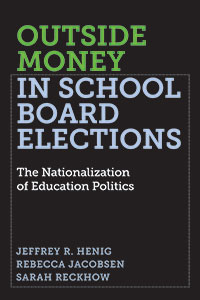
"Outside Money" book cover; black with bold and multicolored words of the title.

Looking at New Orleans, Los Angeles, Denver, Indianapolis and Bridgeport, Conn., the authors explored funding for school board elections from 2008-09 through 2013-14, including more than 18,000 contributions. They found that while education reform, at least in recent years, has trended toward a national focus, people were realizing that local-level decision-making and engagement was important.

And this new engagement came from some big names, including a surprising pattern of individuals—like Reed Hastings, the co-founder and CEO of Netflix, and Michael Bloomberg, former New York City mayor—who gave at least $1,000 to elections across the country, often in more than one place in more than one year.

“We are trying to understand why a donor living in Atherton, Calif. would give to school board candidates thousands of miles away—in places like New Orleans and Indianapolis,” said Reckhow, a faculty member in political science. She helped analyze donor data, including the background of donors and relationships of the donors using social network analysis. “We found that these donors are not simply isolated individuals with an unusual interest in school board elections—these are highly active campaign contributors who also gave large sums to out-of-state congressional elections, and may have shared ties to education-related organizations.”

Sarah Reckhow headshot
Sarah Reckhow

Jacobsen explored the consequences of contributions big and small, including how or if it changed who ran and what issues were talked about during campaigns. By talking with candidates who had participated in these elections, she found that candidates who were not affiliated with deep-pocketed donors or with the unions struggled to gain visibility and get their messages heard.

As one candidate from Denver explained: “If you are a candidate who’s not in those affluent circles, then you are immediately discouraged because you know you can’t compete with that fundraising.”

Local issues—zoning, school district boundaries—seemed to get lost in heavily funded campaigns, and there was a rise in discussion of national issues: for example, campaigns focused on school choice, especially charters, and school and teacher accountability, issues that had previously been debated at the national or state level. Additionally, as more money entered the elections, candidates became more polarized in their stances, being staunchly pro- or anti-charter schools, for example.

“Whether it’s an ideology you agree with or disagree with, it still tends to be more polarized, which is not good for problem solving,” observed one candidate.

“Both sides are talking more about national issues at the expense of localized ones; that’s certainly a concern,” Jacobsen said. “But, it does raise visibility of these elections. In some cases, prior to these outside funding sources, we couldn’t find any coverage of school board elections in the local news. When the money came in, people started paying attention and more information about the elections and the candidates was available.”

Overall, Henig, Jacobsen and Reckhow argue that education politics is entering a new era of nationalization.

These shifts taking place, Reckhow added, do not make local school board politics irrelevant, nor do they imply there is a national takeover of local politics. Instead, they demonstrate that traditional lines of power and decision making are being rearranged with new alliances across local, state and national contexts.

“This book is important for understanding the landscape of education politics today,” she continued. “For teachers, parents, activists, school board members … to see how and why national issues are becoming prevalent in political debates at the local level. Our cases show that local politics is still incredibly important, partly reflected in the immense resources these local elections have attracted. Our book also shows that there is room for agency on the part of local candidates, organizations and mobilized citizens to resist or impact the course of nationalization.”


Related news

Reckhow and Jacobsen have researched school leadership, school boards and elections before.

In 2016, Reckhow, Jacobsen and Henig were among the co-authors on a paper related to this book, published in Urban Affairs Review, that also examined non-local campaign contributions to school board elections.

In 2012, Jacobsen found that Americans still supported local control of their schools in day-to-day operations, but that local, state and federal government should all be involved in education policies.

Programs

  • Undergraduate Programs
  • Master's Programs
  • Doctoral Programs
  • Online Programs

Academic Departments

  • Counseling, Educational Psychology & Special Education
  • Educational Administration
  • Kinesiology
  • Teacher Education

For Students

  • Graduate Support
  • Undergraduate Support
  • Scholarships
  • Assistantships

For Faculty & Staff

  • Communications
  • Data & Analytics
  • Human Resources
  • Policies, Committees & More
  • Tech Services

Our College

  • Office of the Dean
  • Imagin[ED] 2030 Strategic Plan
  • Mission
  • Directory
  • Centers & Institutes
  • Accolades & Awards
  • Rankings
  • Subscribe to our Newsletter
  • "New Educator" Magazine
  • News
  • Jobs

Contact us

(517) 355-1734

Address

Michigan State University College of Education 620 Farm Lane East Lansing, MI 48824

Releases and Statements

Follow Us

  • Visit our Facebook page
  • Visit our page on X
  • Visit our Instagram page
  • Visit our LinkedIn page
  • Visit our YouTube page

If you're having accessibility issues, please let us know.

Know More: Campus Safety Information and ResourcesTransparency Reporting: Budget & Salary/Compensation
  • Contact Information|
  • Site Map|
  • Privacy Statement|
  • Site Accessibility|
  • Call MSU: (517) 355-1855|
  • Visit: msu.edu|
  • Notice of Nondiscrimination|

SPARTANS WILL|© Michigan State University|