Jump to HeaderJump to Main ContentJump to Footer
Michigan State University
College of Education
  • Strategic Plan
  • Resources
  • People Directory
  • Alums
  • Contact
  • Give

College of Education

  • About
    • Mission & History
    • Strategic Plan
    • Points of Distinction
    • Leadership
    • Academic Departments, Centers, Institutes & Offices
    • Faculty and Staff Directory
    • Inclusion & Diversity
    • Outreach Efforts
    • Buildings & Facilities
    • Career Opportunities
    • Ways to Give
    Dean Jerlando Jackson stands in front of a sign that reads Michigan State University.

    Meet Dean Jackson

    Meet Dean Jerlando F. L. Jackson
  • |
  • Academics
    • Majors & Degree-Granting Programs
    • Undergraduate Programs
    • Master's Studies
    • Doctoral Studies
    • Online Studies
    • Graduate Certificates & Specializations
    • Undergraduate Student Support
    • Graduate Student Support
    • Assistantships
    • Scholarships
    • Accreditation
    Five Spartans pose for a photo in a row during an awards ceremony; three are holding paper awards and wearing medallions around their neck with a turquiose ribbon.

    Record-setting KIN Spartans

    Alums make history with national KIN honors
  • |
  • Certifications
    • Become Certified or Add an Endorsement
    • School Psychologist Certification
    • Student Affairs Office
    • MSU Academic Programs Catalog
    • MSU Office of Accreditation, Assessment, Curriculum & Compliance
    Individual bikes on MSU's campus

    Educator Preparation & Accreditation

    Explore our efforts
  • |
  • Research
    • Office of Research Administration
    • Centers & Institutes
    • Student Research Opportunities
    • Research & Award News
    • Faculty Directory
    Individual holds scans of a brain in two hands.

    Uncovering processes that lead to learning outcomes

    Read about our research
  • |
  • Outreach
    • Policy
    • K-12 Schools & Districts
    • Urban Areas
    • International Areas
    • Alumni
    • Institute for the Study of Youth Sports
    • Office of Access & Community Engagement
    • Office of International Studies in Education
    • Office of K-12 Outreach
    • All Offices, Centers & Institutes
    Young children line up for an activity in IM Sports circle. The children wear bright green shirts.

    Detroit youth learn about movement at MSU

    Explore the KIN Day of Action
  • |
  • News & Events
    • News
    • New Educator Magazine
    • Subscribe: ReviewED Newsletter
    • Events Listing
    Kristen Bieda wearing a blue blouse and glasses. There is a bookshelf full of books in the background.

    Celebrating: Kristen Bieda

    Bieda named Department of Teacher Education Chair
College of Education
  • About
  • Academics
  • Certifications
  • Research
  • Outreach
  • News & Events

< About

  • Mission & History
  • Strategic Plan
  • Points of Distinction
  • Leadership
  • Academic Departments, Centers, Institutes & Offices
  • Faculty and Staff Directory
  • Inclusion & Diversity
  • Outreach Efforts
  • Buildings & Facilities
  • Career Opportunities
  • Ways to Give
Dean Jerlando Jackson stands in front of a sign that reads Michigan State University.

Meet Dean Jackson

Meet Dean Jerlando F. L. Jackson

< Academics

  • Majors & Degree-Granting Programs
  • Undergraduate Programs
  • Master's Studies
  • Doctoral Studies
  • Online Studies
  • Graduate Certificates & Specializations
  • Undergraduate Student Support
  • Graduate Student Support
  • Assistantships
  • Scholarships
  • Accreditation
Five Spartans pose for a photo in a row during an awards ceremony; three are holding paper awards and wearing medallions around their neck with a turquiose ribbon.

Record-setting KIN Spartans

Alums make history with national KIN honors

< Certifications

  • Become Certified or Add an Endorsement
  • School Psychologist Certification
  • Student Affairs Office
  • MSU Academic Programs Catalog
  • MSU Office of Accreditation, Assessment, Curriculum & Compliance
Individual bikes on MSU's campus

Educator Preparation & Accreditation

Explore our efforts

< Research

  • Office of Research Administration
  • Centers & Institutes
  • Student Research Opportunities
  • Research & Award News
  • Faculty Directory
Individual holds scans of a brain in two hands.

Uncovering processes that lead to learning outcomes

Read about our research

< Outreach

  • Policy
  • K-12 Schools & Districts
  • Urban Areas
  • International Areas
  • Alumni
  • Institute for the Study of Youth Sports
  • Office of Access & Community Engagement
  • Office of International Studies in Education
  • Office of K-12 Outreach
  • All Offices, Centers & Institutes
Young children line up for an activity in IM Sports circle. The children wear bright green shirts.

Detroit youth learn about movement at MSU

Explore the KIN Day of Action

< News & Events

  • News
  • New Educator Magazine
  • Subscribe: ReviewED Newsletter
  • Events Listing
Kristen Bieda wearing a blue blouse and glasses. There is a bookshelf full of books in the background.

Celebrating: Kristen Bieda

Bieda named Department of Teacher Education Chair
  • Strategic Plan
  • Resources
  • People Directory
  • Alums
  • Contact
  • Give

May 9, 2011

Under the Radar Screen

Are Contingent Faculty Transforming Higher Education?

Summary

The American college faculty is undergoing a major transformation that has gone largely unnoticed. In recent years, the number of faculty eligible for long-term (tenured) appointments has declined while the number of faculty on short-term (contingent) contracts has ballooned. Today, more than half of the instructional workforce in U.S. colleges and universities holds contingent appointments, either full-time or part-time (American Association of University Professors, 2010). In other words, fewer faculty have long-term relationships with their institutions, colleagues and students.
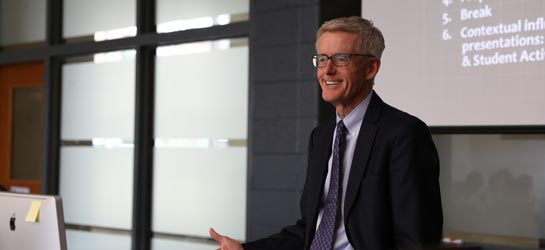
By: Roger Baldwin

The American college faculty is undergoing a major transformation that has gone largely unnoticed. In recent years, the number of faculty eligible for long-term (tenured) appointments has declined while the number of faculty on short-term (contingent) contracts has ballooned. Today, more than half of the instructional workforce in U.S. colleges and universities holds contingent appointments, either full-time or part-time (American Association of University Professors, 2010). In other words, fewer faculty have long-term relationships with their institutions, colleagues and students.

Roger Baldwin leads a class

This transformation of the academic profession is not the result of a thoughtful public dialogue on the future of higher education or research on conditions that promote effective teaching and learning. Nor was it mandated by government policy or fostered by well-reasoned analysis by independent foundations. The move to greater use of contingent faculty (full-time and part-time) has been a gradual process resulting from incremental staffing decisions in an era of tight budgets. This trend has also been driven by the need to preserve program flexibility in a time of rapid change with shifting enrollment patterns. Over the course of two to three decades, the American faculty has tipped from a largely stable workforce to one that is rapidly evolving as conditions change.

Just what this staffing shift means for students and for the quality of education is unclear because this change in faculty staffing has occurred with little attention to its educational impact. This should be a major concern for academic leaders and policymakers. As increasingly diverse students come to higher education with varied levels of preparation and skill, it is essential that they work with educators who are well prepared to deliver quality instruction and able to give students the time and attention essential to their academic success.

Research my MSU colleague Professor Matthew Wawrzynski and I report in a forthcoming special issue of the American Behavioral Scientist suggests that this staffing trend may have negative consequences that have been overlooked as institutions hire growing numbers of contingent faculty.  Our analysis of data from the 2004 National Study of Postsecondary Faculty identified significant differences in the teaching practices of contingent part-time faculty and faculty (both tenure-eligible and contingent) with full-time faculty appointments. We learned that part-time faculty were less likely than their full-time colleagues to use learning-centered teaching methods (e.g., essay exams, course papers, group projects, multiple drafts of written work). Part-time faculty were also less likely to employ technology in their teaching (e.g., communicating with students via e-mail, using web pages in instruction). There clearly is a need to look more deeply at the instructional practices of full-time and part-time faculty. However, these initial findings suggest that the trend toward more part-time contingent faculty may inhibit the use of instructional practices that can make education more learning centered and more responsive to diverse students. This is a worrisome trend as many institutions hire more part-time faculty to cope in a time of limited resources and increasing demands for new educational programs.

The quality of an educational institution is directly related to the expertise, skill and working conditions of its faculty. As colleges and universities navigate a challenging environment, they must monitor trends in their faculty staffing to insure a healthy balance of instructors with different types of appointments. In addition, institutions should require and support quality teaching by all faculty, not just those with long-term or full-time positions. Finally, colleges and universities should consider converting part-time positions to full-time faculty jobs when possible. Institutions can recruit from a larger, and probably higher quality, pool of applicants when they offer a full-time rather than a part-time appointment. In addition, full-time faculty can concentrate their energy on the responsibilities of just one job rather than two or more which is often the case for part-time faculty. Full-time positions can give faculty the time to invest in enhancing their teaching and develop supportive relationships with their students—key hallmarks of a quality higher education institution.

Programs

  • Undergraduate Programs
  • Master's Programs
  • Doctoral Programs
  • Online Programs

Academic Departments

  • Counseling, Educational Psychology & Special Education
  • Educational Administration
  • Kinesiology
  • Teacher Education

For Students

  • Graduate Support
  • Undergraduate Support
  • Scholarships
  • Assistantships

For Faculty & Staff

  • Communications
  • Data & Analytics
  • Human Resources
  • Policies, Committees & More
  • Tech Services

Our College

  • Office of the Dean
  • Imagin[ED] 2030 Strategic Plan
  • Mission
  • Directory
  • Centers & Institutes
  • Accolades & Awards
  • Rankings
  • Subscribe to our Newsletter
  • "New Educator" Magazine
  • News
  • Jobs

Contact us

(517) 355-1734

Address

Michigan State University College of Education 620 Farm Lane East Lansing, MI 48824

Releases and Statements

Follow Us

  • Visit our Facebook page
  • Visit our page on X
  • Visit our Instagram page
  • Visit our LinkedIn page
  • Visit our YouTube page

If you're having accessibility issues, please let us know.

Know More: Campus Safety Information and ResourcesTransparency Reporting: Budget & Salary/Compensation
  • Contact Information|
  • Site Map|
  • Privacy Statement|
  • Site Accessibility|
  • Call MSU: (517) 355-1855|
  • Visit: msu.edu|
  • Notice of Nondiscrimination|

SPARTANS WILL|© Michigan State University|