
By: Dorinda Carter Andrews, Terah T. Venzant Chambers, Chezare A. Warren
We live in a society where schools are not only touted to be sites of learning and innovation, but also safe spaces. On most days, the average parent or guardian sends their child to school giving no second thought to whether s/he will be cared for, listened to or embraced by adult and youth members of the school community. In a country that prides itself on the rich diversity of its people, one should be able to assume that schools are places where diverse identities are welcomed and affirmed.
In the last two years, the number of students of color in U.S. public schools has outnumbered white students, with the largest increase being among Hispanic students.1 Additionally, the Center for Immigration Studies reports that roughly 23 percent of all public school students come from immigrant households, with the largest percentage increases in immigration from largely Muslim nations (e.g., Saudi Arabia, Bangladesh, Iraq).2 Schools ought to cultivate environments where the ideology of America as a nation that values pluralism and cultural diversity is an enacted practice. However, we know that realizing this ideal has been problematic for some time.
Since the election of Donald Trump as the 45th president of the United States, there has been a surge in the number of hate crimes and acts of violence against people of historically and traditionally marginalized groups (e.g., immigrants, Muslims, African Americans, LGBTQ individuals). The majority of these incidents have occurred in K-12 schools—the places where our most vulnerable members of society should feel safe and protected. The Southern Poverty Law Center (SPLC) has been collecting reports of harassment and discrimination occurring throughout the country since Election Day. In the first five weeks following the election (between Nov. 9 and Dec. 12, 2016), approximately 1,100 incidents were documented by the SPLC.3 These bias incidents target those who are perceived as immigrant, Black, Muslim and/or LGBTQ. Michigan schools have not been immune to students’ experiences with hostility and discrimination post-election. Recently, two of us were asked to provide perspectives on ethnically charged incidents occurring in one Michigan school district following the election.4 As the second half of this academic year continues, we all must consider how to lead and educate in ways that allow students to maintain their full humanity and dignity.
Leading and teaching in these turbulent times requires a commitment to uphold the educational rights of all students, regardless of one’s moral, ethical and political beliefs. And it requires a focus on ensuring that school and classroom culture and climate emanates humanity, dignity and respect for all students. Here, we offer a few key strategies and resources for school leaders and teachers as they model civility and promote equity and inclusion in schools. This is not intended to be a comprehensive list of “what educators should do to counter hate in schools.” However, because our children our watching, there are immediate steps that should be taken.
School leaders: Create an inclusive school culture
Multiple times each day, school leaders face decisions that must be made. They talk with parents, support teachers, nurture students—and respond to all that email. In the tide of getting through each day, thinking about how to respond to the uncertainty many students in our school communities are feeling might seem like an overwhelming task. However, to foster the kind of environment that allows for rich teaching and learning, attending to school culture is critical.
There are two important pieces to responding to the post-election climate in which we find ourselves. First, we must work to create a supportive, inclusive school community that fosters a sense of belonging. Schools that do this well incorporate five important aspects into their school culture:
Steps for school leaders
- Cultivating inclusive school norms and values
- Fostering a sense of belonging for all students
- Embracing age-appropriate conversations about diversity and social justice
- Rethinking the use of tracking and ability grouping
- Supporting positive relationships between students and school personnel5
While there are no quick fixes to these issues, research confirms that responding to these aspects of school culture can have a positive effect on teaching and learning.
Second, while proactively addressing issues of school climate will likely reduce these kinds of incidents, we also need to be ready to respond when they happen. School leaders can develop action plans6 that outline what the response will look like for a variety of possible incidents. Having a plan in place ahead of time will ensure everyone knows what to do when harassment and discrimination happens. The key in these situations is to be informed and act swiftly.
Classroom teachers: Speak out against intolerance
Notwithstanding the incredibly important role of school leaders to establish school-wide norms for civility and mutual respect for cultural difference, classroom teachers stand on the front lines. They are likely the first adults in the school building to hear about incidents of hate, or to witness unjust or prejudiced interactions between school stakeholders. The present sociocultural and political climate compels us to admonish teachers to take an active stance against intolerance and injustice. Our recommendation is simple. Avoid silence:
Steps for teachers
- Acknowledge incidents of assault in the school community by communicating care and concern for, and directly to, those involved.
- Abstain from questioning the merits of a victim’s claim or wholesale dismissing the feeling of marginalization.
- Make teaching tolerance a routine part of the instructional decision-making process.7
- Create space and time for youth to discuss world events (e.g. Aleppo, Standing Rock, extrajudicial killing of unarmed Black women and men). Expose youth to evidence of injustice.8
- Collaborate with school leaders, support staff and colleagues to create a plan to respond appropriately to trauma at the classroom level.9
As educators, we know firsthand how uncomfortable conflict and confrontation can feel for teachers. Silence about injustice committed against minoritized populations is similar to an ethos of colorblindness. Not pointing out the discomfort, or not seeing race, for example, does not mean the discomfort (or racialized disparity) goes away. If nothing else, the discomfort intensifies and the oppression persists. As a result, the classroom environment—either immediately or over time—feels less safe for individual members of the community. We insist that avoiding silence humanizes the classroom space such that every single young person feels they can rely on her or his teacher to carefully cradle their vulnerability and respond appropriately.
We can help
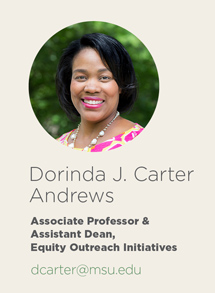
MSU has a wealth of resources. Alumni should not hesitate to reach out to the network of colleagues, faculty and other friends who can become part of a school’s response plan for addressing acts of hate and violence. Under the leadership of Dorinda Carter Andrews, the College of Education has instituted Equity Outreach Initiatives. This effort involves providing professional education that can assist educators, community organizations and corporations in creating and sustaining equitable communities by centering issues of race, culture, power and privilege in learning and work environments. You can look forward to hearing more about upcoming opportunities in the near future.
Learn more
education.msu.edu/outreach/equity
Authors

References
1. nces.ed.gov/programs/digest/d13/tables/dt13_203.50.asp
2. washingtonexaminer.com/census-record-42.4m-immigrants-23-of-school-kids-muslims-biggest-jump/article/2603543
3. https://www.splcenter.org/hatewatch/2016/12/16/update-1094-bias-related-incidents-month-following-election
4. wkar.org/post/msu-experts-detail-school-community-challenges-after-ethnic-harassment#stream/0
5. For more detail about these aspects of school culture, see Venzant Chambers, T. T. & Huggins, K. S. (2014). School factors and racial opportunity cost for high achieving students of color. Journal of School Leadership, 24(1), 189-225.
6. See michigan.gov/documents/safeschools/MI_Ready_Schools_Emergency_Planning_Toolkit_370277_7.pdf for one example of such a plan.
8. See Warren and Lessner’s “Who Has Family Business? Exploring the Role of Empathy in Student-Teacher Interactions.”
9. The film “Paper Tigers” might be a good resource to begin a discussion of how to respond to student trauma, as well as how adults might themselves avoid being retraumatized. Also see the work of Carter Andrews for considering how to create personal action plans.